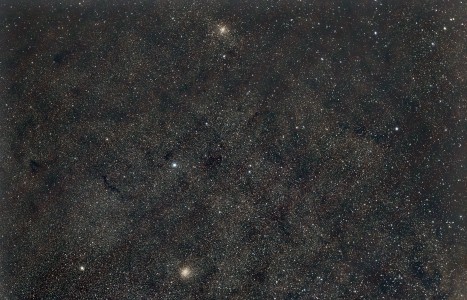
Ever wonder, while observing the Andromeda galaxy, if there is some one in Andromeda looking at you and wondering the same thing? Well, there likely is!
Start with the Drake equation, using very conservative estimates. Let the rate of (solar type) star formation be 0.3 stars per year. Assume only 20% of those develop planetary systems (again, very conservative). Now assume 20% of those are earth-like, meaning at the right distance from their sun to allow suitable atmospheric and temperature conditions. Now assume 5% of those develop life (again, conservative compared with some accepted estimations). For the probability of live evolving intelligent life, lets use a factor of 50%, since evolution favors intelligent life. The next factor is the lifetime of the technical civilization. Let's say it's 10,000 years, a guess since we really cannot logically estimate it. These numbers then result in a calculation of three intelligent civilizations in Andromeda (or the Milky Way, a similar spiral galaxy).
Start with the Drake equation, using very conservative estimates. Let the rate of (solar type) star formation be 0.3 stars per year. Assume only 20% of those develop planetary systems (again, very conservative). Now assume 20% of those are earth-like, meaning at the right distance from their sun to allow suitable atmospheric and temperature conditions. Now assume 5% of those develop life (again, conservative compared with some accepted estimations). For the probability of live evolving intelligent life, lets use a factor of 50%, since evolution favors intelligent life. The next factor is the lifetime of the technical civilization. Let's say it's 10,000 years, a guess since we really cannot logically estimate it. These numbers then result in a calculation of three intelligent civilizations in Andromeda (or the Milky Way, a similar spiral galaxy).
