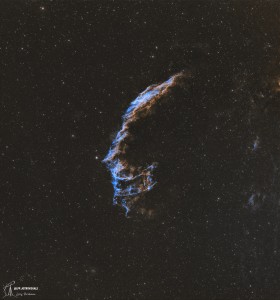

Camelopardalis is a larger constellation than you might realize and it offers some impressive objects primed for winter viewing. I enjoyed viewing one of them from the front of my home on Wednesday evening, November 19.
NGC 1501, listed in the Observer's Guide as having a magnitude of 11.5, seems much brighter than it's apparent magnitude, which seems to differ depending upon the source. I found it, big and bright in my 16" dob, with a 9mm es ocular, without a filter, despite high ambient light pollution. Using a broadband filter enhances the view, and the Observer's Guide notes this planetary resembles the Eskimo Nebula in Gemini. Here's Skyhound's take on it:
http://observing.skyhound.com/archives/dec/NGC_1501.html
This object takes high power quite well so don't be afraid to crank it up!
Clear, dark and steady skies to you...
