Image of the day

Captured by
Byron Davies

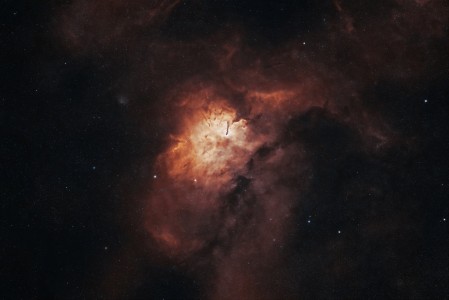
Sh2-86 (NGC-6820)

My Account

New to Astromart?

Register an account...

Need Help?

Messier object Magnitude

Started by ZWAY2B, 06/07/2006 03:36PM
Posted 06/07/2006 03:36PM Opening Post
Can someone school me please? This spring I attempted my first Messier marathon and of course mother nature only allowed about 3 clear hours of observation, but I was puzzled by the published Mags and my actual observations. How do they calculate Mag for an object with multiple objects like a cluster or an object that varies in Mag? Is it the brightest component? some statistical average? or something else? I had a hard time with some bright objects and easily found some dimmer ones.

Thanks Dave
Posted 06/07/2006 04:00PM #1
A good question. While it am not sure how any
given catalog computes it, generally it would be the
total for the entire object.

So the telescopic visibility of some object would
depend both on the magnitude and size. If two objects
have the same magnitude, but one is very large and
spread-out and the other is small and compact, the
compact one will be much easier to pick out from
the sky background light.
Posted 06/07/2006 04:35PM #2
Well, you gotta watch out here. In the first place, there are diferent uses of the terms "magnitudes."

When we talk of magnitude of the star, we are talking about the total amount of light coming from a point source. That is, all the light is coming from a single point. This is pretty easy to compare.

However, when talking about deep space objects, we are talking about the total amount of light coming from an area. To compare these magnitudes, one must take into account the size of the area. And this is much more difficult.

Another similar concept is "surface brightness." Surface brightness is, well, the brightness (or amount of light) coming from a given area. When you add up all the surface brightnesses, you get a "magnitude" for an deep space object. When you are talking about "point sources" such as stars, there is only one area to add up--the point of the star--but you still get a magnitude.

At any rate, compare a tungsten filament to a flourescent bulb. The tungsten filament is much brighter--puts out more photons (has a higher surface brightness--more light per unit of area) than any one small part of the flourescent tube. However, the Flourescent Tube is much, much larger. As a result, the the Flourescent bulb can put out as much overall brightness as a tungsten filament, even though the tungsten filament has a much brighter surface area.

OK, back to the stars. M42 may have more total light output than a sixth magnitude star-- But it is spread out over a larger distance. Therefore, no one part of it shows through.

M33, for instance, has a pretty bright overall magnitude, but it is so large, that it appears rather dim (has a low surface brightness).
In addition to this little explanation, remember that various measures of magnitude depend on visual, photographic, wavelength of light, and so forth. The eye is more sensitive to some colors, etc. So, there is no one "magnitude" for a celestial object.

Alex
Posted 06/08/2006 08:43AM #3
There's a definition of integrated magnitude at
http://www.daviddarling.info/encyclopedia/I/integrated_magnitude.html

The concept of surface brightness is an important factor in determining the visibility of galaxies. Surface brightness is measured in magnitudes per square arcminute. Under dark skies, a DSO with a surface brightness of 12.5 or brighter should be detectable with almost any telescope. However, if the surface brightness is 14.5 or fainter, the object will be a real challenge to observe.

Face-on spiral galaxies are often hard to detect (M74 is considered to be the most difficult object in the Messier Catalogue) and the expansive M101 has the highest surface brightness figure of all the Messier galaxies, which in this case is not a good thing at all.

Here's a list of the Messier galaxies, their integrated visual magnitudes, and their surface brightnesses:

M31 3.4 13.6
M32 8.1 12.7
M33 5.7 14.2
M51 8.4 12.6
M58 9.7 13.0
M59 9.6 12.5
M60 8.8 12.8
M61 9.7 13.4
M63 8.6 13.6
M64 8.5 12.4
M65 9.3 12.4
M66 8.9 12.5
M74 9.4 14.4
M77 8.9 13.2
M81 6.9 13.0
M82 8.4 12.8
M83 7.6 13.2
M84 9.1 12.3
M85 9.1 13.0
M86 8.9 13.9
M87 8.6 12.7
M88 9.6 12.6
M89 9.8 12.3
M90 9.5 13.6
M91 10.2 13.3
M94 8.2 13.5
M95 9.7 13.5
M96 9.2 12.9
M98 10.1 13.2
M99 9.9 13.0
M100 9.3 13.0
M101 7.9 14.8
M104 8.0 11.6
M105 9.3 12.1
M106 8.4 13.8
M108 10.0 13.0
M109 9.8 13.5
M110 8.1 13.9

For more on surface brightness see http://mysite.verizon.net/vze55p46/id18.html

Dave Mitsky

Chance favors the prepared mind.

De gustibus non est disputandum.
