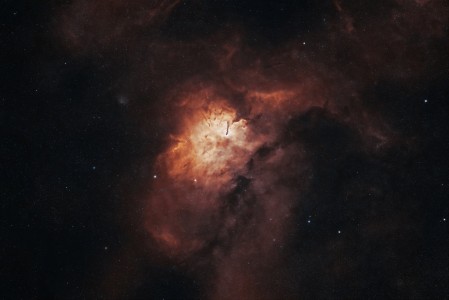
Here is my report from Mexico City.
Contrary to my expectations, I found the skies rather clear and not very light-polluted, at least to the South proper. This is because my hotel was on the elevated Southern rim of the city whose boul filled with smog could be seen in the North. I observed from the hotel terrace that featured a grotesque 10m high chair installed on it for advertising (of what?). Because of the time difference I woke up every morning at 3 to 4am and went to the terrace, which gave me access to Scorpius/Sagittarius area and Jupiter. I observed four mornings for one to two hours. All mornings were clear, and all evenings were cloudy, so I hadn't looked at Sirius - I was too sleepy after 6pm anyway. Seeing was worse than I expected, but one morning it was around 8. I used my 80mm APO on a light Bogen tripod with geared head, a bit shaky but light and good for travel. My faithful Karkoschka, red lamp, MP3 player or mobile phone for logging, Ultima 30 and 18mm and 2x Barlow and Burgess TMB planetary 4 and 6mm completed my setup (I wisely left Naglers and Panoptics at home).
My primary targers were Jupiter and Antares (I hope Inge will not delete my post because of that). Jupiter was high up and stunning. I saw a lot of small details in NEB, long oblique white ovals and blue festoons in NEZ, thin interrupted EB, bright STZ sharply defined against SPR. Once I saw Ganymede transit - its bright dot was very obvious against darker NPR. Later GRS rotated into view, with a hint of detail inside it.
I could not resolve Antares on the first night. The second night the seeing improved, but I still could not see the companion. At dawn I gave it another try at 300x - and there it was, a small white star on or just outside the pale orange diffraction ring, preceding. It was easier than Eta Geminorum. I knew the position angle, but I managed to ignore the separation, so I didn't known what to expect. I could see the companion the next night as well; to check that I was not fooling myself I looked at Epsilon Bootis that was in zenith - and I saw a fat blue star sitting on the diffraction ring!
At this point I realised that I could run the Southern leg of my Messier survey. Scorpius was stunning, I've never seen it so high before. The views of globular clusters were much better than I had from Italy in ST80. M4 was extremely beautiful - resolved at 90x except for the central vertical bar with its vertical chain of stars on the nebulous background. It took half of FOV at 140x. M80 showed a star-like core, grainy halo and some outliers. I had an impression of total resolution in M22; there was a dark intrusion from beneath on the following side. The other globulars showed not much resolution but a huge variety in size, brightness and concentration. M30 was most difficult to find at dawn; I could only detect it at high power.
80mm of aperture shines on open clusters, and there is a lot of them in Scorpius. M7 could be seen by naked eye as a large nebulous spot. At 20x it was a fabulous sight - widely thrown brilliant apochromatic white-blue stars arranged in groups. The Northern Jewel Box was a tight group of six bright stars with a lot of smaller stars around them. M6 really looked like a butterfly, but I find it more interesting to try to imagine its 3D structure instead of joining dots.
The second night was most transparent of all, and I had very good views of the diffuse nebulae M8 and M17. I only made two mistakes here - forgot my UHC filter at home and missed M16 on the map in the dark. I could see bright nebulosity in Trifid, but no detail. At last I had a good view of M24 - it was really a could of bright, small and very small stars at low power. High power showed a nebulous background behind them, all cut by dark lanes of galactic dust. At one point I was scared by coming clouds - only to realise that it was Milky Way in Sagittarius!
I spent a lot of time with the single galaxy of the trip, M83, and its neighbour M68. 3am was really a little too late for them, and I didn't have good views. M83 was more like lumpy darkness, very mottled and rather large. At high power I could clearly see a round nebulous core forming an obtuse triangle with two stars at its sides. M68 was grainy and only weakly concentrated.
My last target at the dawn of the last day was Venus, sharp and brilliant. The lit side had two small horns - refraction of light in planet's atmosphere.
All in all, it was my best astro-travel so far (even though the views of Eta Carinae from Brazil make a good competition). The food was very good, and the Mexican people are very helpful and honest - I got back my back pack with my passport, computer, camera, MP3 player and other stuff that I left in the taxi after 18 hours on the road.
Dmitri

