I finally realised my dream of acquiring a 12.5-inch Portaball as my personal scope. This is an older version with non-Zambuto optics (an excellent mirror, though) bought from John Rennekamp, Jackson, Tenesse. I made a two day trip to the US to pick it up, and I'm highly satisfied with the consideration and helpfulness of John. Anyone buying from him will definitely be satisfied.
I made a preliminary test the day after I returned home, just to realise that I had an in-focus problem with my orthoscopic eyepieces. I'm now awaiting a remedy from Pete Smitka to resolve this.
Sunday evening, however, the sky cleared up, and I had the opportunity to borrow some TeleVue eyepieces from a friend. We got about an hour observation time before fog came in from the ocean, but this gave me a first impression of the scope.
I'm upgrading from an 8-inch Portaball, and clearly there is a great leap from 8 to 12.5-inches of aperture. My first target was M37, a good object for the 8-inch, and GREAT in the new scope. The orange colour of the star near the centre of the cluster was striking.
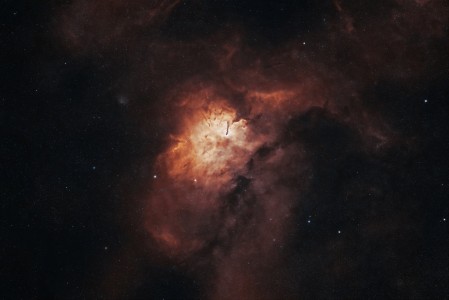
M36 was a bit loose for the magnification I used (94x). The nearby emission nebula, NGC1931 was extremely bright, and for the first time I noticed a double star embedded in it.
M35 was also a great view, although it does not appear very compressed at higher powers. The background cluster, NGC2158, however, was beautiful. It appeared large and bright, and many stars were visible against a backgorund haze.
The amount of detail of the Orion nebula and other nebulae in the region was so great. I look forward to many great observing sessions to explore this region.
Just before the fog came in we observed Saturn with a 6mm Radian giving 250x power. The image was crisp and sharp, showing features on the planet's surface as well as the ring system. The scope definitely has a potential of higher magnifications, and I look forward to the double stars.
For me the 12.5-inch Portaball is the ultimate scope. It is so easy to handle that there is no excuse for leaving it in its shed, and it seems to be a great performer both at low and high power.

