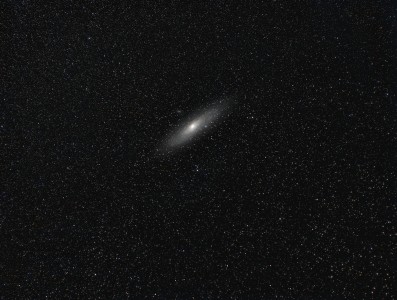
For today I have chosen one of the Messier objects. M38 is one of the most prominent open clusters in Auriga. Since the cluster is pretty large and relatively loose it stands best out with low magnification, and it is, indeed, a very fine object for binoculars.
I think many experienced observers tend to overlook objects like M38. I admit that I have done this myself. Even with the lowest magnification I have on my 12.5-inch (63x) it covers almost the whole field of view and since it isn't much concentrated towards the centre, it appears more as a local enrichment of the background star field. Lately, however, I have found it quite rewarding to pay some attention to M38. While at first glance the cluster seems to be just a gathering of 8th magnitude stars, closer scrutiny shows the presence of many fainter stars. Some of them certainly are background stars, but I find many nice star patterns within the cluster. In addition M38 has a smaller and more compressed companion, NGC1907, near its edge. I find that viewing these two objects together is very nice.
I think many experienced observers tend to overlook objects like M38. I admit that I have done this myself. Even with the lowest magnification I have on my 12.5-inch (63x) it covers almost the whole field of view and since it isn't much concentrated towards the centre, it appears more as a local enrichment of the background star field. Lately, however, I have found it quite rewarding to pay some attention to M38. While at first glance the cluster seems to be just a gathering of 8th magnitude stars, closer scrutiny shows the presence of many fainter stars. Some of them certainly are background stars, but I find many nice star patterns within the cluster. In addition M38 has a smaller and more compressed companion, NGC1907, near its edge. I find that viewing these two objects together is very nice.
