I went out observing last Friday with a person who wanted to learn how to locate some good objects without needing any technical aid (BTW the owner of the 18-inch Dob which I sometimes have the pleasure to use). Two evenings earlier he demonstrated his ability to find M27, M57, M13 the Veil complex and, of course, the Andromeda Galaxy. This evening, we used my 12.5-inch Portaball, and went for some of the other good objects for this time of the year.
We started with the Saturn nebula, NGC7009. From our latitude this planetary is a bit low, but it was possible to make out the "Saturn" shape, and a greenish colour was obvious at a magnification of 167x.
Next we turned to M71 which is a nice cluster and quite easy to find from the Sagitta asterism. About eqally easy to locate is M56 using Beta Cygni and Beta Lyrae as reference stars. Both clusters are relatively well resolved in the 12.5 inch. A magnification of 167x is well suited for both clusters.
M2 is a bit more difficult to locate since the distance to the nearest bright stars is pretty long. I use Alpha and Beta Aquarii as reference stars, and imagine the cluster being near the top of an isosceles triangle with the two stars. My friend was surprised by the brightness and richness of this cluster, and wes even more impressed by M15. (We don't have access to the wonders of Sagittarius)
We then turned to some of the interesting nebulae of Cygnus. Pointing the telescope at the North America nebula isn't difficult. Seeing it in a telescope with a 1 degree field, however, may be pretty hard. However, the Mexico region stood quite well out with the O-III filter. While in this region we also observed the planetary, NGC7027 using Nu and Xi Cygni as guide stars. Maybe not an impressive object, but relatively easy to locate. More interesting is the blinking planetary, NGC6826. The blinking effect was quite obvious with the 167x magnification.
Strangely enough, my friend found the Crescent nebula more easy to see than the North America nebula. It is, indeed, much fainter. Its approximate position is relatively easy to find going from Gamma towards Beta Cygni. But the star field is extremely crowded, and the nebula is easily overlooked. It may be smart to use the O-III filter during the search. Our observing conditions were below average with clouds coming and going, but it was possible to make out quite some detail in the nebula.
Planetary nebulae are interesting since they come in a variety of sizes and shapes. We therefore also observed NGC6210 in Hercules (a bit difficult to find), M76 in Perseus (very easy to find) and bright NGC7662 in Andromeda which appears much bluer in colour than most other planetaries.
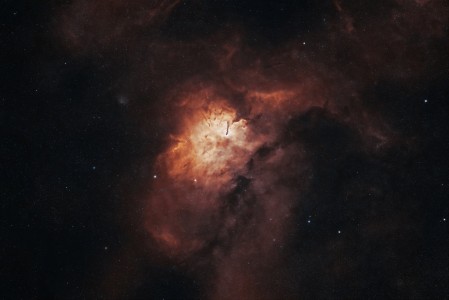
Finally we observed two objects in Cassiopeia, the great cluster, NGC7789 and the interesting nebula NGC281 with the fine multiple star, Burnham 1 in the centre. This nebula is difficult without a filter, and O-III works miracles on it.
Next evening when we are out with the 18-inch, I expect that my pupil will locate all these objects by himself. He plans to install digital setting circles, but still it is nice to be able to locate a few of the show objects without the assistance of a computer.
Inge S
