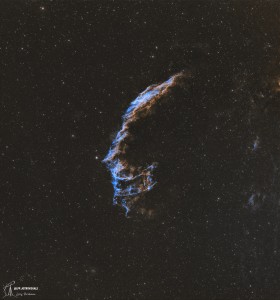
Observing planetary nebulae is fun, because they come in all kinds of sizes and shapes. I observed several nice ones from La Palma. The well known ones from the northern sky (M27, M57) were awesome, of course. Among the brighter ones in the "new" part of the sky, were the Ghost of Jupiter (which I was able to observe from home with some difficulty) and NGC3132, the "Eight Burst Nebula". Another nice, pretty bright one was NGC6818 in Sagittarius, an object that shouldn't be forgotten by anyone who has observed Barnards galaxy - it is located just slightly north-west of the galaxy.
The oddest of all planetaries must be the Bug nebula near Lambda Scorpii. It really resembles a bug.
A couple of the southern nebulae were clearly annular. The "Little Ghost Nebula", NGC6369 in Ophiuchus was almost like a miniature edition of M57. Also Shapley-1 in Norma was annular. It appeared a bit larger than 6369, not extremely bright, but would probably have been a very good object at a higher altitude above the horizon.
I really enjoyed the sight of the open cluster/planetary nebula, NGC2818 in Pyxis. I had to catch it just after nightfall, and it was low above the western horizon. Although this cluster/nebula combo is fainter than M46/NGC2438 in Puppis, it is very nice in a 12-inch, and I find it strange that it isn't more famous.
The most difficult of the planetaries I observed during my trip was the box nebula, NGC6309 just north of Eta Ophiuchi. When I first pointed the scope at the position where I expected to find the nebula I noticed two double stars in the field, but couldn't find the nebula. Blinking with the O-III, however, made me suspect the fainter of the two double stars, and after increasing the magnification to 167x, I saw that one of the components of this "double", indeed, was the nebula. Its brightness wasn't impressive, and it was quite small with a pecuoiar shape. The "Box nebula" is probably an appropriate name for it.
I didn't observe the Helix nebula. The horizon in the east was blocked by mountains. The good thing about this, of course, is that there are still some great objects on the to-do list, together with all the great galaxies of the autumn sky and the wonders of Southern Canis Major, Lepus, Puppis and Eridanus.
Inge S
