Hello Mike,
You have a nice period of interesting exploration ahead. I never owned a 5-inch scope myself, but I have some experience with smaller refractors (as well as larger reflectors that I'm currently using). I have never been a person being able to push the telescope to its extreme limits, therefore I think you can consider my statements as realistic for an average person.
Open star clusters (good examples, M37, M11) are easily resolved in your telescope, and will be very beautiful objects. Normally you don't need very high magnification for open clusters.
Globular star clusters (M3, M13, M92 and many more) may appear as hazy spots at first glance, but a closer look you will see that the sky is sprinkled by tiny stellar points. Globular clusters often look best at average magnification, perhaps 100x with the 5-inch.
Gaseous nebulae actually come in several classes.
Reflection nebulae like the Merope nebula in the Pleiades will appear faint and featureless, and is considered to be rather difficult objects.
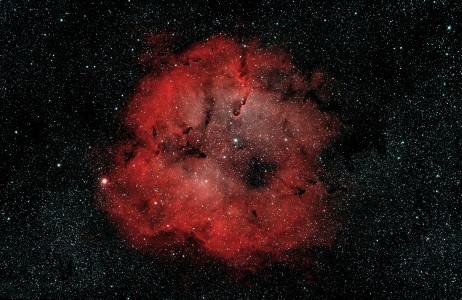
Emission nebulae (e.g. M42 in Orion and M17 in Sagittarius) vary very much in size and brighness. The Orion nebula will have a lot of beautiful detail even in a small scope. With a larger telescope such nebulae may show even more detail if a filter (O-III or UHC) is applied. I'm not sure how well filters will work with a 5-inch.
Planetary nebulae also come in different shapes and sizes. Some of them are nearly stellar, while others are large and very diffuse. I'm sure you will enjoy observing the ring nebula, M57 and the beautiful M27 in Vulpecula.
You should not be too optimistic about detecting spiral structure in galaxies with 5 inches of aperture. You may see hints of it in M51, but to begin with I recommend to look for the general shape of the brighter ones (face-on vs. edge-on spirals etc.). The Andromeda galaxy is an awesome object, but don't forget the galaxy pair M81/M82, M51, M94, M33). Several hundred galaxies are within range of your telescope.
Finally, don't forget the double stars. Hunting for doubles may be very rewarding, and can give you many nice challenges.
Good luck,
Inge S
