Image of the day

Captured by
John Roach

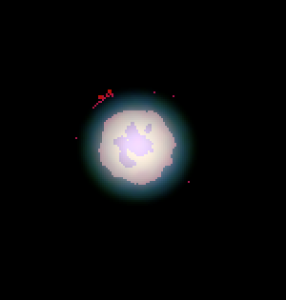
Enhanced Uranus showing Polar Cap and possible Aurora

My Account

New to Astromart?

Register an account...

Need Help?

Some recent deep-sky sketches

Started by jeyjey, 11/30/2008 10:32AM
Posted 11/30/2008 10:32AM Opening Post
I haven't posted here in ages, but I thought I'd share a couple of recent observing reports.

Over the summer I acquired both Alvin Huey's and Kanipe & Webb's Arp Peculiar Galaxies books, but I'm a bit embarrassed to say that I hadn't used either in anger yet. I finally got a chance to correct that on Thurs night.

This was a short session due to having spent all day cooking. I was also using a plan that had been prepared for October (which lay unused due to cloudcover) -- so I just picked a couple of the later (RA-wise) ones which were still fairly well-placed.

Conditions were mixed: better than average seeing for my site, but worse than average transparency.

Arp331 11/27/2008 23:30UT; Pickering 8, NELM 5, SQM 20.4

5 direct-vision plus 1 averted-vision galaxies. NGC383 the brightest, but 380/379 readily visible to the NNE and 384/385 somewhat less so to the S. NGC386 could only be teased out with averted vision; holdable perhaps 35% of the time but easily re-acquired.

NGC380 has stellar core; NGC379 slightly larger but with a less condensed core. NGC383 has largest core, elongated somewhat NNE-SSW. NGC384 and 385 show very weak semi-stellar cores under averted vision.

Note: Arp331 is probably an example of where I should have gone out with a chart -- I expect with a bit of prompting and knowing where to look I could have found NGC387 and possibly even 388. But I still have a preference for taking my first observation of a target "blind" (so that I'm unbiased in recording what I see).

Arp158 11/27/2008 23:55UT; Pickering 8, NELM 5, SQM 20.4

Small elongated streak, but without the swelling so typical of edge-on spirals or lenticular galaxies. Two brighter knots, both semi-stellar in appearance; one at E end and second about 2/3 of the way to the W end, connected by a brighter bar. Dimmer knot between the other two not seen, nor was the exceedingly faint extension to the ESE.


-- Jeff.
Posted 11/30/2008 10:35AM #1
Going back a bit farther, I got a couple of short nights in a row at the beginning of October:

The 2nd showed mediocre seeing and transparency. First up was a sketch of the Cat's Eye prompted by a thread on CloudyNights. (Well, first up was about 40 minutes of vacuuming dead flies from my observatory, but I assume you all don't want to hear about that.)

NGC6543 Cat's Eye 2 Oct 2008, 22:40UT; Pickering 5, NELM 5.5, SQM 20.5
16" APM Mak-Cass, AP1200GTO

Like many planetaries, this one looks completely different in the eyepiece from photos. I wasn't able to make out any of the internal shells, but several of them condense to show a brighter crescent to the NNE somewhat surrounding the central star. There are also wisps of much dimmer material, most prominently to the SW and NE.


I then spent about an hour trying to see Gyulbudaghian's Nebula (actually a Herbig-Haro object). I don't know why I keep at it -- this was my fourth attempt with no luck.

Next up was Stephan's Quintet, but I wasn't able to make out anything beyond the two brighter components. It was then that I discovered that I didn't have my dew heater cranked up enough, and the center of my corrector was a bit fogged so I called it a night.

Monday showed considerably better seeing and marginally better transparency. I returned to the Cat's Eye first, but even in Pickering 7 I was unable to resolve any of the internal shells. So I went back to Stephan's Quintet.

HCG92 Stephan's Quintet 3 Oct 2008, 21:10UT; Pickering 7, NELM 5.5, SQM 20.6
16" APM Mak-Cass, AP1200GTO

The pairing at the center showed itself first, with a fairly obviuos bi-polar nature, but poor condensation. The more elongated member to the SE was also fairly easy, with a more marked condesation. These members were somewhere between direct and averted-only, but from there it got much more difficult.

I originally sketched the SW member as a star, but study of it at 450x revealed that it never resolved as tightly as other field stars of similar magnitude. It is very dim, with a semi-stellar core.

The NE component nearly alluded me. No condensation what-so-ever, quite small and considerably dimmer than the others. Not holdable in averted-vision, but there perhaps 50% of the time, and easily re-acquired once I had found it a couple of times.

A chart of the field would have helped greatly here, but I still don't trust myself not to have averted imagination, so I don't like to bring charts out.


With reasonable success on Stephan's, I thought I'd see how many of NGC7331's fleas I could find.

NGC7331 3 Oct 2008, 21:45UT; Pickering 7, NELM 5.5, SQM 20.6
16" APM Mak-Cass, AP1200GTO

NGC7331 is quite bright with a well-condensed, elongated core. The brightest and most extended flea to the ENE shows itself first; the other two I captured have semi-stellar cores and took 450x to differentiate from dim field stars.


Well-pleased with how that went I tackled one more.

NGC7332 and NGC7339 3 Oct 2008, 22:10UT; Pickering 7, NELM 5.5, SQM 20.6
16" APM Mak-Cass, AP1200GTO

NGC7332 slightly brighter than 7331, but 7339 considerably dimmer. 7332 shows a well-condensed core while 7339 shows no core at all. Both of similar size and proportions, with 7332 perhaps being a bit more pinched at either end.


Cheers,
-- Jeff.
Posted 11/30/2008 12:19PM #2
Jeff
Excellent renderings!

Matt
Posted 12/03/2008 03:56PM #3
Jeff,

Great work! I prefer the immediacy and intimacy of observing at the eyepiece rather than at the computer and post-processing of imaging. It would be nice to see a Sketching Forum here on Astromart.
Posted 12/03/2008 04:25PM #4
Thanks Warren and Gerald!

I too wouldn't mind seeing a sketching forum. The one on CloudyNights sees quite a bit of action.

Cheers,
-- Jeff.
