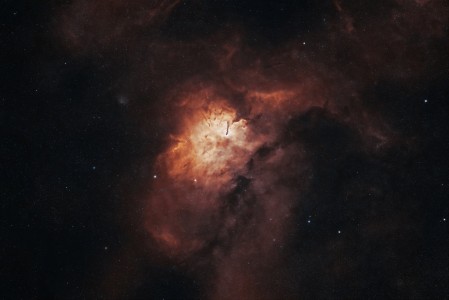
Much has been written and discussed about this object. Although it appears faint and featureless in a small scope it is a popular and frequently observed target. The view of M1 improves a lot when increasing the aperture from 8 to 12.5 inches, and still further up to 18 inches. But even with 18 inces of aperture I can so far not claim to have seen the filaments of this nebula. Possibly it is possible to imagine seeing something with averted vision even in a 12.5-inch.
I observing guides detection of the filaments is claimed to be possible with a scope in the 10 - 12-inch range, but I find this a bit optimistic. Are there anyone out there who have really seen the filaments? What aperture was used? Do filters help?
In fact we observed M1 with the 18-inch during our last session, but for some reason we didn't think about filters (having both UHC and O-III available). The nebula was large, bright and impressive, but if any filaments could be seen, they were very faint and unconspicuous.
Inge S


