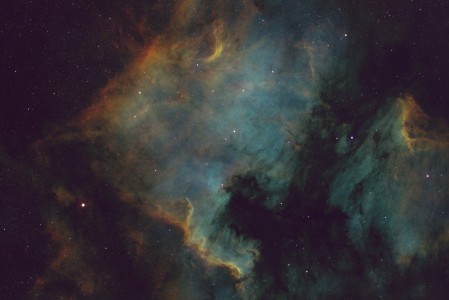
From Scandinavia the diffuse nebulae of the Sagittarius region are always very low in the sky and hard to observe due to interfering sunlight. With some luck M16 and M17 can be seen from Norway, but the views from here are dim and blurry compared to what could be achieved from La Palma.
We observed M17 through the Portaball. Starting at low magnification and trying with and without O-III we soon realised that there was potential to see more. I think we went up to 300x before Dmitri was satisfied. This nebula contains an enormous amount of delicate detail. It is possible to see the same through the eyepiece as in many photos, but while many photos overexpose the brightest parts the human eye is capable of seeing structure in both the bright and faint parts of the nebula at the same time. Also for M17 it is a good idea to allow it drift across the field of view.
It is difficult to tell which is more beautiful, M17 or M8. Possibly the nebulosity of M17 is a shade brighter, but the form of M8 competes with any artist's painting. Also M8 benefits from the use of an O-III filter. It is huge, and fills a one-degree field of view if the faint outer whisps are included. Although M42 is even larger and brighter and (as I'm told by people who have seen it) the Eta Carinae nebula is still more impressive, my opinion is that M8 is the most beautiful of the diffuse nebulae - with or without a filter.
M20 is another superb object. Its dark lanes became immediately obvious also in the 8-inch f/4. It is enhanced by filters, but its enigmatic glow appears nicer to me without. Observing it from La Palma was a particularly great experience since the multiple star at the centre (as well as all other stars) appeared as needle-points although it wasn't very high in the sky.
M16 is also worth mentioning. The dark obscuring clounds were glimpsed without a filter, but were enhanced by O-III. If M16 was placed 10 degrees further north, we would have spent quite a lot of time with it from our latitudes. The only easily acessible diffuse nebula from Scandinavia that competes with it is M42.
We observed many other diffuse nebulae (In Cassiopeia/Cepheus and the winter sky). In order to avoid too long posts I'll return to them later.
Inge S
Inge S
