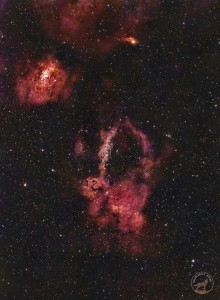
Seeing as how complex this is I'm understandably a little confused and overwhelmed by trying to comprehend this...
I've read in both Sagan and Hawking's work that (to my understanding) space is curved and flat. The way Sagan explains it is that the fabric of space is basically like the inside skin of an inflated ballon, expanding at an enormous speed as the skin of a ballon would do when inflated. The reason everything seems to be in red shift, ie moving away from us, is because the skin or fabric of space itself is expanding. Ok, this makes sense to me - so far I'm following.
Now, my question is, if space is basically a flat, curved "fabric" on which all matter is embedded why do we see galaxies and the like from different perspectives? Using this line of thinking the only way we should be able to see a face-on galaxy is if it is far enough away from us to be facing us on what we precieve to be the elevated or declined portion of this so-called "fabric" of space.
Am I making sense?
