Sculptor contains some of the most beautiful galaxies in the sky. Unfortunately navigation in this region in the sky is rather difficult (not a problem for high-tech astronomers, though). We observed the most famous of the galaxies in this region from La Palma. The highlights were NGC253 and NGC55, but also NGC300, NGC134 and NGC247 (In Cetus) are worth mentioning. This post contains my impressions - but I'm sure that Dmitri can add interesting information.
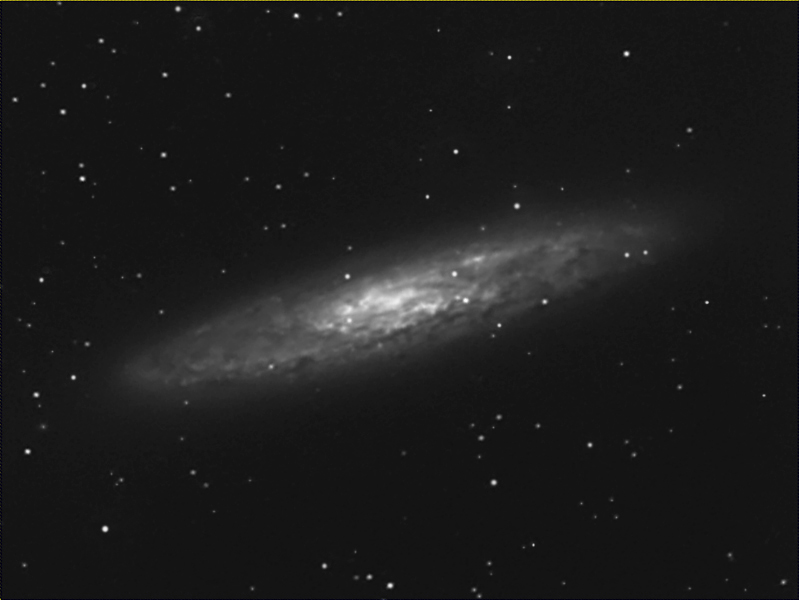
NGC253 is an extremely beautiful object. Its outline is a nearly perfect ellipse, and the surface brightness is relatively high, but varies a lot over the area. This is a huge galaxy which extends outside the field of view even with moderate magnification. Obscuring nebulae are obvious at first glance. With higher power high brightness patches appear - obviously starburst regions or emission nebulae. Hints of spiral structure can be made out. Particularly the arm along the south-western edge is easy to see. For me a dream came true as I allowed the galaxy to drift across the field of view at 115x magnification. No photo can justify the view seen directly through the eyepiece under such conditions.
The second brightest and largest Sculptor galaxy is NGC55. This is also a galaxy with a huge apparent size, and although it is a bit fainter than 253 it is still an impressive object. It resembles NGC253, but is even more elongated and a bit irregular. The brighter parts are asymmetrically placed - the north-western part being the brightest. Also NGC55 contains obscuring patches and lanes. A superb galaxy.
NGC300 is a moderately large spiral galaxy with some foreground stars making observation of its details a bit difficult. It appears as a slightly smaller and fainter edition of NGC2403 in Camelopardalis.
NGC134 is another fine object. It is a tilted spiral. At first glance its light appears to fall off abruptly along one of its edges. With more attention is becomes obvious that the reason for this is an absorbing lane.
Finally, NGC247 in Cetus should be mentioned. This galaxy can possibly be seen even from Norway, but it is much better from a location further south. It appears as an elongated ellipse oriented almost north - south with a star at one of the ends. A pretty large object with a rather low surface brightness. An interesting galaxy with an appearance through the eyepiece that can't be confused with any other galaxy in the sky.
Inge S