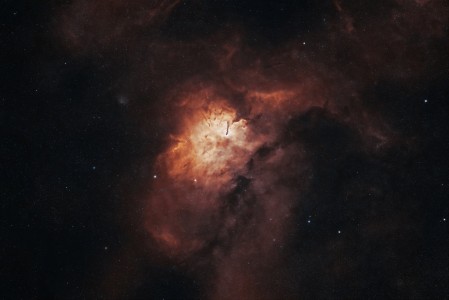
During one of my observing sessions last week I observed some planetary nebulae. One of them, IC2003 in the southern part of Perseus, was new to me. I have been looking for it on several occasions before, but missed it even though it is bright enough for a much smaller telescope than mine. The problem is that it is very small and looks almost like a star at low magnification. Under poor seeing conditions it is impossible to recognise it as a nebula at 63x. This evening seeing was very good and I had a suspicion of its position already before I applied the blinking technique with my O-III filter. At 167x it appeared as a neat, round greyish evenly illuminated disc. Not a show object, but well worth the search.
Over the border to Taurus is another planetary which has become one of my favourites in the sky. NGC1514 is a much neglected object, perhaps because it requires a filter for a good view. Without a filter it looks like an ordinary star surrounded by some faint haze, very much like the impression you get of any star with some dew on the eyepiece. The O-III filter works wonders with this nebula. It reduces the brightness of the central star a bit while the nebula is greatly enhanced. To me this is a textbook example of a planetary. The nebula is round with well defined edges. The nebulous disc is not even in brightness, but contains several dark spots. The central star is clearly visible.
I have observed this nebula several times, and I find it quite sensitive to observing conditions. The sky background must be dark and seeing should also be good. With my 12.5-inch a magnification of 115x is near perfect.
Inge S
