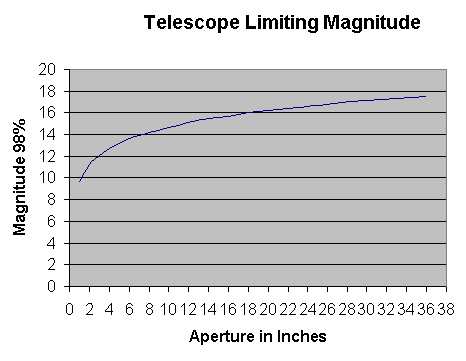
Here is a table to try to determine the probability or detection of an object.
You will note, while the probability gets lower the faint object just might be seen by a smaller aperture.
Floyd
Telescope Limiting Magnitude
Aperture Probability of Detection
Inches 98% 90% 50% 20% 10% 5% 2%
1 9.7 10.2 10.7 11.2 11.7 12.4 13.2
2 11.2 11.7 12.2 12.7 13.2 13.9 14.7
3 12.1 12.6 13.1 13.6 14.1 14.8 15.6
4 12.7 13.2 13.7 14.2 14.7 15.4 16.2
5 13.2 13.7 14.2 14.7 15.2 15.9 16.7
6 13.6 14.1 14.6 15.1 15.6 16.3 17.1
7 13.9 14.4 14.9 15.4 15.9 16.6 17.4
8 14.2 14.7 15.2 15.7 16.2 16.9 17.7
10 14.7 15.2 15.7 16.2 16.7 17.4 18.2
12.5 15.2 15.7 16.2 16.7 17.2 19.9 18.7
14 15.5 16.0 16.5 17.0 17.5 18.2 19.0
16 15.7 16.2 16.7 17.2 17.7 18.4 19.2
18 16.0 16.5 17.0 17.5 18.0 18.7 19.5
20 16.2 16.7 17.2 17.7 18.2 18.9 19.7
22 16.4 16.9 17.4 17.9 18.4 19.1 19.9
24 16.6 17.1 17.6 18.1 18.6 19.3 20.1
30 17.1 17.6 18.1 18.6 19.1 19.8 20.6
36 17.5 18.0 18.5 19.0 19.5 20.2 21.0
[SIZE="Large"][/SIZE][COLOR="Blue"][/COLOR] Floyd Blue

Amateur Imager