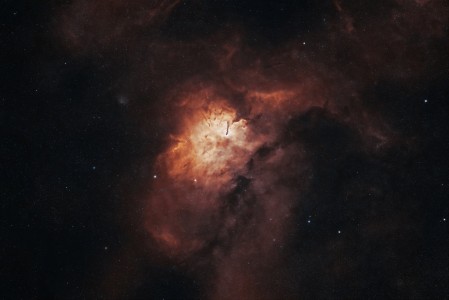
The nebulae of the winter sky were morning objects for us observing from La Palma. We got Orion and Canis Major and most of Monoceros well above the horizon before the onset of morning twilight.
There were many highlights among the gaseous nebulae in this region too. I saw the California nebula for the first time in my life. With the 8-inch f/4 , 32x magnification and a H-beta filter. With this combo this faint and ill-defined object looked surprisingly bright, and its shape left no doubt why it got its popular name.
Another object looking great through the wide-field scope was the Rosette complex. Once again, a filter helped enhancing the view. I'm always amazed by the views of the Rosette nebula with an O-III filter. Even from home a lot of detail can be made out, including obscuring bok globules. From La Palma the amount of detail in the 8-inch was about the same as with the 12.5-inch from home. Without a filter, the nebula is almost invisible. A large, faint patch is seen with some effort north-west of the central cluster.
M42 was beautiful beyond words from this dark site. It could be traced further than from home, of course. But still more important was that the stars involved were sharp needle points and not blurry patches as those we see with the nebula low in the sky and Norwegian seeing conditions. The Trapezium, of course, caught a lot of attention. All 6 stars were seen with ease with all our telescopes. Even some hint of colour in the nebulosity could be seen, the brighter parts appearing green, while some of the fainter whisps looked violet. These colours are very subtle, and nobody should expect colours like those on photos seen through the eyepiece. But once again, I prefer the soft glow seen visually.
Even M43 had an interesting appearance. I always considered M43 to be a featureless nebulosity surrounding its central star. With the Orion nebula complex, however, we played around with magnification, and I was very surprised to find that M43 also was framed by dark nebulosity giving it a quite complex outline. I suppose I'm going to see some of this from home too - time will show.
The nebulosity near Zeta Orionis is not impressive from light polluted sites. With the dark southern skies, the faint patches turned out to be quite bright and crisscrossed by dark lanes. The sight of it with a 13mm Nagler and Zeta just outside the field of view was just unforgettable. It reminded me of a nicely structured maple leaf. I prefer viewing this nebula without a filter. At least I don't find the O-III to be beneficial - possibly the UHC is.
Then, the great challenge - the Horsehead nebula. Yes, we all saw it through the Portaball with 24mm Panoptic and H-beta. The background nebulosity appeared quite bright with this filter, and the obscuring nebula was apparent as a dark gulf. I couldn't make out the horsehead shape - didn't even expect it. My younger, more sharp-sighted friends, however, claimed to glimpse it. Dmitri could even see the Horsehead nebula without the filter. Unfiltered I had difficulties even seeing the faint background nebulosity.
Inge S
