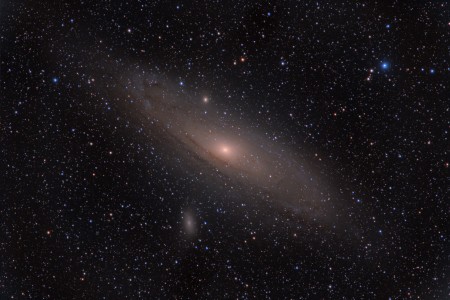
Image of the day

Captured by
Ruben Tommasi

Andromeda Galaxy (M31)

My Account

New to Astromart?

Register an account...

Need Help?

Full Hunter's Moon at Perigee - Oct 25/26

Started by curtrenz, 10/04/2007 05:15PM
Posted 10/04/2007 05:15PM Opening Post
Look for a huge Full Hunter’s Moon during the night of 2007 OCT 25/26! Coincidentally, it will be near the time of the Moon’s closest perigee distance of the period from 2005 FEB to 2008 NOV. This month’s greatest fraction of illumination (99.90%) of the Moon’s apparent disk as viewed from Chicagoland will occur on the 25th at 21:54 CDT. Geocentric perigee of 356,753 km will occur on the 26th at 06:53 CDT with the Moon’s geocentric angular diameter at 33.5 arcminutes. Too bad this fortunate combination of events will not be happening six evenings later for the Trick or Treaters on Halloween! 8)

For astronomical graphics, including
monthly wallpaper calendar, visit:
CurtRenz.com/astronomical

Curt Renz
Posted 10/14/2007 03:11PM | Edited 10/14/2007 05:57PM #1
I’ve created a graphic that demonstrates the variations in the declinations, distances and angular diameters among the 15 Full Moons from 2007 APR 02 to 2008 MAY 20. It can be seen at http://www.curtrenz.com/astronomical.html

Full Moons (or any particular phases) go through a complete cycle of distances from Earth every 14 lunar (synodic) months or 1.13 years. The coming Full Moon on OCT 25/26 will be near perigee and the closest of the current cycle. The most extreme perigees coincide with Full Moons. The first and last Full Moons shown on the chart were near apogees.

The top portion of the chart shows the variation in declination of the Full Moons. To determine each Full Moon’s altitude at meridian transit for your location, add the declination (south is negative) to your co-latitude (90° - latitude). This variation goes through an annual cycle than is opposite to that of the Sun: The Full Moon is higher in winter and lower in summer. Additionally, there is an 18.6-year cycle in which the amplitude of the declinations varies: most extreme in 2006 and least in 2015.

Across the lower center of the chart is shown the Earth and Moon in proper scale with the distances noted in thousands of kilometers (Mm or megameters).

At the bottom of the chart is shown the differing angular sizes of the Moon resulting from the changes in distance. wink

For astronomical graphics, including
monthly wallpaper calendar, visit:
CurtRenz.com/astronomical

Curt Renz
Posted 10/25/2007 11:56PM #2
Here's a picture I took from Arlington Heights, Illinois of the full Hunter’s Moon near perigee on 2007 OCT 25 at 17:46 CDT. That was 25 minutes after moonrise and 10 minutes before sunset.

Also in the picture are three airplanes and a flock of geese headed south for the winter.

It was taken with my Sony Cyber-shot DSC F717 at full 5x zoom, ISO 100, F/2.4 and 1/1000 sec. The original was cropped and then reduced to 52% of the linear dimensions.


For astronomical graphics, including
monthly wallpaper calendar, visit:
CurtRenz.com/astronomical

Curt Renz
