Image of the day

Captured by
John Roach

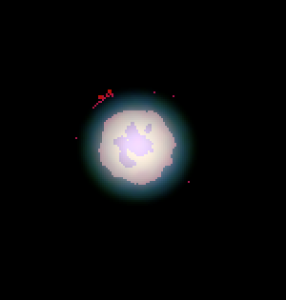
Enhanced Uranus showing Polar Cap and possible Aurora

My Account

New to Astromart?

Register an account...

Need Help?

Lunar Quiz #3

Started by curtrenz, 07/23/2005 05:53PM
Posted 07/23/2005 05:53PM Opening Post
Here’s another lunar quiz for all you great lunatics out there. The first one to answer all five questions correctly earns the right to add one more. Hopefully the baton will keep passing for quite a while. Good Luck! wink


1) The maximum phase of the next lunar eclipse on 2005 OCT 17 at 12:03 UT will be:

A) Penumbral
B) Partial 6%
C) Partial 49%
D) Partial 92%
E) Total


2) The next solar eclipse on 2005 OCT 03 will be:

A) Partial at best (Arctic region)
B) Partial at best (Antarctic region)
C) Annular
D) Total
E) Hybrid (both annular and total)


3) During the current era the mean Earth-Moon distance is increasing by what amount per century?

A) 3.8 centimeters
B) 3.8 meters
C) 380 meters
D) 38 kilometers
E) 3800 kilometers


4) Which of the following first magnitude stars is not one that the Moon occults during the period 1900-2100?

A) Aldeberan in Taurus
B) Pollux in Gemini
C) Regulus in Leo
D) Spica in Virgo
E) Antares in Scorpius


5) When during the period 1990-2020 does the Moon reach its most extreme geocentric declinations, 28°43’ North and South of the Celestial Equator?

A) 1996 AUG/SEP
B) 2001 FEB/MAR
C) 2005 JUN/JUL
D) 2006 MAR/APR
E) 2015 OCT/NOV

For astronomical graphics, including
monthly wallpaper calendar, visit:
CurtRenz.com/astronomical

Curt Renz

Posted 07/27/2005 11:39PM | Edited 07/28/2005 07:40PM #1
Apparently few people want to take quizzes during the summertime. OK, here are the answers with explanations.

1) The maximum phase of the next lunar eclipse on 2005 OCT 17 at 12:03 UT will be:

B) Partial 6%

We're living during a long stretch of the 586-year eclipse cycle in which total lunar eclipses are more common than usual. When we do get partial lunar eclipses during our era, they are often quite minor ones. The next total lunar eclipse will come on 2007 MAR 03. For those of us in Chicago the Moon will rise around sunset that evening while in total eclipse. The October partial eclipse will reach maximum in Chicago just before it sets near dawn.


2) The next solar eclipse on 2005 OCT 03 will be:

C) Annular

It will be visible in portions of Spain and Africa. An annular eclipse occurs when the Moon appears smaller than the Sun presenting an entire ring of sunlight around the dark Moon. They are really not much more interesting than partial solar eclipses, of which annulars are really just an unusual type. The true majesty of Mother Nature is brought forth with a total solar eclipse. The next total one will occur on 2006 MAR 29 for observers in parts of Africa, Turkey and Asia.


3) During the current era the mean Earth-Moon distance is increasing by what amount per century?

B) 3.8 meters

This value had been approximately known since Newton's time. But it was nailed down after Apollo astronauts placed a laser reflector on the Moon. It amounts to only 3.8 centimeters per year or 3 millimeters per lunar month. Some sources will tell you that the recession is due to transfer of angular momentum from the Earth as it slows in its rotation. That's not an explanation of the physical cause for the Moon to move outward; it's merely the expected result. Ocean tides are caused mainly by the Moon and create a friction that slows the Earth's rotation. That friction drags the tidal bulge ahead of the spot where the Moon is in the Zenith. That bulge then gravitationally tugs at the Moon giving it enough added momentum to move into a higher orbit.


4) Which of the following first magnitude stars is not one that the Moon occults during the period 1900-2100?

B) Pollux in Gemini

Those who were paying attention during an earlier lunar quiz got this one easily. Pollux was last occulted by the Moon in 117 BC. Since then its proper motion has moved it out of range of the Moon. The other four stars are regularly occulted during certain periods within the 18.6-year cycle of the Moon's nodes.


5) When during the period 1990-2020 does the Moon reach its most extreme geocentric declinations, 28°43’ North and South of the Celestial Equator?

D) 2006 MAR/APR

That will be near the time when the Moon's ascending node lies near the vernal equinox. The Moon's orbital plane is inclined by 5.15° to the ecliptic (Earth's orbital plane.) At times during the 18.6-year cycle of nodes this is added to the 23.44° tilt of the ecliptic to the equator. At the opposite point of the cycle it is subtracted. So now we are in a period in which the Moon transits extremely high when in the constellations of Taurus or Gemini and exceptionally low when in Scorpius or Sagittarius. wink

For astronomical graphics, including
monthly wallpaper calendar, visit:
CurtRenz.com/astronomical

Curt Renz