
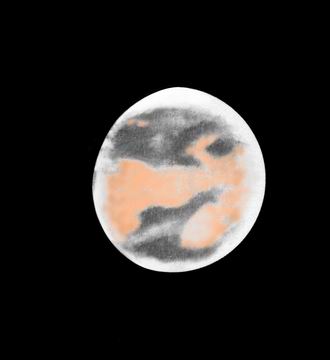
I have attached an observation of Mars I made this morning (08:15 U.T.). I noted much detail over the disk as can be seen in my drawing. Any comments will be welcome. The best of luck in your own observations and imaging.
Date (U.T.): April 1, 2003
Time (U.T.): 08:15
CM: 053.9
LS: 161.1 (Martian Northern Summer)
De: -10.0, Ds: 7.8, Phase (k): 0.88
Instrument: 9-inch (23-cm) F/13.5 Maksutov-Cassegrain
Magnification: 282x and 352x
Filters (Wratten): 23A and 80A
Seeing (1-10): 5-6 (brief moments of 7/10), Antoniadi (I-V): III
Transparency (1-6): 6
Notes:
South Polar Limb Haze (SPLH): Appears brilliant 10/10 and obscures the south polar limb.
Mare Erythraeum: Appears dark (3/10) with a central bright (7/10) area (Pyrrhae Regio?).
Aurorae Sinus: Appears dark (3/10) connecting to the south to Bosporos Gemmatus (3/10).
Argyre I/II: Appears shaded to bright (6-7/10) adjacent to the SPLH.
Solis Lacus: Appears dark (3/10) and oval-shaped. Adjacent to an extremely bright (9/10) morning limb haze (MLH).
Chryse-Xanthe: Appears bright (7/10), but no other detail noted within.
Cydonia: Appears bright (7/10) adjacent to an extremely brilliant evening limb haze (ELH).
Niliacus Lacus: Appears dark (3/10) and separated from Mare Acidalium (3/10) to the north by a bright (7/10) haze over Achillis Pons.
Tempe: Appears bright to very bright (7-8/10) following Mare Acidalium.
Tharsis: Appears bright to extremely bright (7-9/10) towards the following limb.
Regards,
Carlos E. Hernandez
P.S. This is no joke.
Date (U.T.): April 1, 2003
Time (U.T.): 08:15
CM: 053.9
LS: 161.1 (Martian Northern Summer)
De: -10.0, Ds: 7.8, Phase (k): 0.88
Instrument: 9-inch (23-cm) F/13.5 Maksutov-Cassegrain
Magnification: 282x and 352x
Filters (Wratten): 23A and 80A
Seeing (1-10): 5-6 (brief moments of 7/10), Antoniadi (I-V): III
Transparency (1-6): 6
Notes:
South Polar Limb Haze (SPLH): Appears brilliant 10/10 and obscures the south polar limb.
Mare Erythraeum: Appears dark (3/10) with a central bright (7/10) area (Pyrrhae Regio?).
Aurorae Sinus: Appears dark (3/10) connecting to the south to Bosporos Gemmatus (3/10).
Argyre I/II: Appears shaded to bright (6-7/10) adjacent to the SPLH.
Solis Lacus: Appears dark (3/10) and oval-shaped. Adjacent to an extremely bright (9/10) morning limb haze (MLH).
Chryse-Xanthe: Appears bright (7/10), but no other detail noted within.
Cydonia: Appears bright (7/10) adjacent to an extremely brilliant evening limb haze (ELH).
Niliacus Lacus: Appears dark (3/10) and separated from Mare Acidalium (3/10) to the north by a bright (7/10) haze over Achillis Pons.
Tempe: Appears bright to very bright (7-8/10) following Mare Acidalium.
Tharsis: Appears bright to extremely bright (7-9/10) towards the following limb.
Regards,
Carlos E. Hernandez
P.S. This is no joke.
Attached Image:
