
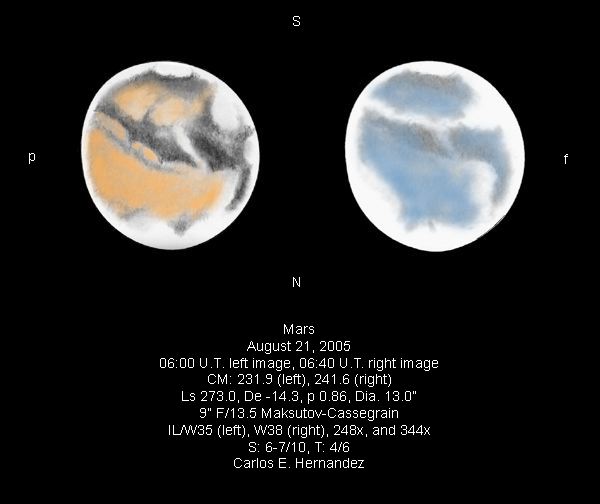
I made a pair of observation of Mars on August 21, 2005 (06:00 (IL/W35) and 06:40 U.T. (W38)) which showed interesting detail over the martian surface and atmosphere. The South Polar Cap (SPC) was prominent. The region between Mare Cimmerium and Syrtis Major was complex (alternating light and dark patches). Hellas was extremely bright (9/10) and prominent. I welcome any comments on my observations.
Date (U.T.): August 21, 2005
CM: 231.9 (left), 241.6 (right)
Ls 273.0 (Early Northern Winter/Southern Summer)
De -14.3, Dia. 13.0", p 0.86
Instrument: 9-inch (23-cm) F/13.5 Maksutov-Cassegrain
Magnification: 248x and 344x
Filters (Wratten): 35 (magenta) and 38 (blue)
Seeing (1-10): 6-7, Antoniadi (I-V): III-II
Transparency (1-6): 4
Notes:
Left Image (06:00 U.T., IL/W35): The South Polar Cap (SPC) appeared brilliant (10/10) and prominent. No detail was noted within the SPC. Mare Chronium (3-4/10) was visible north and surrounding the SPC. Simois (4-5/10) was visible extending between the southern border of Mare Cimmerium and Mare Chronium, bisecting Phaethontis (7/10) and Electris (7/10). Eridania (7/10) was visible as well. Mare Cimmerium (3-4/10) was visibly extending from the south-preceding limb and following the CM. A bright (7/10), circular albedo feature (Atalantes Depresio?) was noted over the southern border of Mare Cimmerium adjacent to Hesperia (7-8/10). The diffuse (5/10) albedo feature "Valhalla" was noted to be north and parallel to Mare Cimmerium. Mare Tyrrhenum (3-4/10) and Syrtis Minor (3/10) were prominent following the CM. The region appeared "speckled" during brief moments of steady seeing. Mare Hadriacum (3/10) was noted along the preceding border of Hellas (9/10). Syrtis Major (3-4/10) was noted as a "wedge" along the following limb. Iapygia Viridis (3/10) was visible towards the following limb south of Syrtis Major. Aeolis, Aethiopis, and Aetheria were bright (7/10) with little detail visible. Cerberus (5/10) was visible as a thin wedge south of the extremely bright (9/10) North Polar Hood (NPH). Libya (7-8/10) appeared to be partially obscured by haze. The Hyblaeus Extension (?, 3-/4/10) was visibly partially obscured by the NPH. A thin, extremely bright (9/10) morning limb haze (MLH) was visible. A more prominent (9/10) evening limb haze (ELH) was visible as well.
Right Image (06:40 U.T., W38): The South Polar Cap (SPC) was brilliant (10/10). Hellas was extremely bright (9/10) and appeared to have a thin, bright to very bright (7-8/10) projection extending from it's preceding border then across Eridania and Electris and connecting to the extremely bright MLH (possible mixture of ground fog and water-ice clouds?). A very bright to extremely bright (8-9/10) cloud was visibly projecting over Elysium. The North Polar Hood (NPH) was extremely bright (9/10) as well. Mare Chronium, Mare Cimmerium, Mare Tyrrhenum, Syrtis Minor, and Syrtis Major were diffusely visible using the blue (W38) filter.
The best of luck in your own imaging and observations of the red planet.
Regards,
Carlos E. Hernandez
Date (U.T.): August 21, 2005
CM: 231.9 (left), 241.6 (right)
Ls 273.0 (Early Northern Winter/Southern Summer)
De -14.3, Dia. 13.0", p 0.86
Instrument: 9-inch (23-cm) F/13.5 Maksutov-Cassegrain
Magnification: 248x and 344x
Filters (Wratten): 35 (magenta) and 38 (blue)
Seeing (1-10): 6-7, Antoniadi (I-V): III-II
Transparency (1-6): 4
Notes:
Left Image (06:00 U.T., IL/W35): The South Polar Cap (SPC) appeared brilliant (10/10) and prominent. No detail was noted within the SPC. Mare Chronium (3-4/10) was visible north and surrounding the SPC. Simois (4-5/10) was visible extending between the southern border of Mare Cimmerium and Mare Chronium, bisecting Phaethontis (7/10) and Electris (7/10). Eridania (7/10) was visible as well. Mare Cimmerium (3-4/10) was visibly extending from the south-preceding limb and following the CM. A bright (7/10), circular albedo feature (Atalantes Depresio?) was noted over the southern border of Mare Cimmerium adjacent to Hesperia (7-8/10). The diffuse (5/10) albedo feature "Valhalla" was noted to be north and parallel to Mare Cimmerium. Mare Tyrrhenum (3-4/10) and Syrtis Minor (3/10) were prominent following the CM. The region appeared "speckled" during brief moments of steady seeing. Mare Hadriacum (3/10) was noted along the preceding border of Hellas (9/10). Syrtis Major (3-4/10) was noted as a "wedge" along the following limb. Iapygia Viridis (3/10) was visible towards the following limb south of Syrtis Major. Aeolis, Aethiopis, and Aetheria were bright (7/10) with little detail visible. Cerberus (5/10) was visible as a thin wedge south of the extremely bright (9/10) North Polar Hood (NPH). Libya (7-8/10) appeared to be partially obscured by haze. The Hyblaeus Extension (?, 3-/4/10) was visibly partially obscured by the NPH. A thin, extremely bright (9/10) morning limb haze (MLH) was visible. A more prominent (9/10) evening limb haze (ELH) was visible as well.
Right Image (06:40 U.T., W38): The South Polar Cap (SPC) was brilliant (10/10). Hellas was extremely bright (9/10) and appeared to have a thin, bright to very bright (7-8/10) projection extending from it's preceding border then across Eridania and Electris and connecting to the extremely bright MLH (possible mixture of ground fog and water-ice clouds?). A very bright to extremely bright (8-9/10) cloud was visibly projecting over Elysium. The North Polar Hood (NPH) was extremely bright (9/10) as well. Mare Chronium, Mare Cimmerium, Mare Tyrrhenum, Syrtis Minor, and Syrtis Major were diffusely visible using the blue (W38) filter.
The best of luck in your own imaging and observations of the red planet.
Regards,
Carlos E. Hernandez
Attached Image:

 )

