
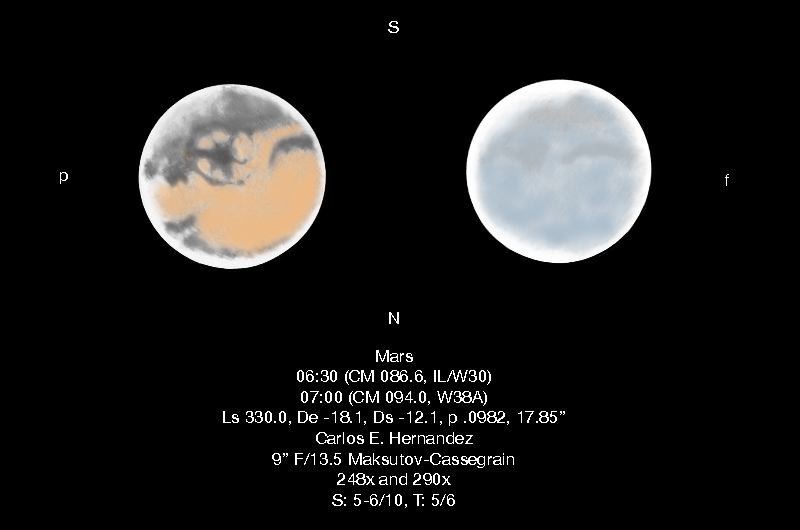
I made a pair of observations of Mars on November 25, 2005 (06:30 and 07:00 U.T.) under average (5-6/10) seeing conditions. Much detail was noted over the southern hemisphere, especially the Solis Lacus region. I welcome any comments on my observations.
Date (U.T.): November 25, 2005
Time (U.T.): 06:30 (left image) and 07:00 (right image)
CM: 086.6 (left image) and 094.0 (right image)
Ls: 330.0 (Mid-Late Northern Winter/Southern Summer)
De -18.1, Ds -12.1, p 0.982, 17.85"
Instrument: 9" F/13.5 Maksutov-Cassegrain
Magnification: 248x and 290x
Filters (Wratten): 30 and 38A
Seeing (1-10): 5-6, Antoniadi (I-V): III
Transparency (1-6): 5
Notes:
06:30 U.T. (Left image, IL/W30): The South Polar Cap (SPC) was very small and brilliant (10/10) surrounded by a dark (3/10) collar. Mare Australe appeared dusky to dull (4-5/10) and mottled. Solis Lacus was visible just preceding the CM appeared dark to dusky (3-4/10) with northern (Geryon (5/10) and Calydon (4/10)) and southern (Ambrosia (5/10) and Bathys (4/10)) projections over Thaumasia (7/10). Solis Lacus appeared to be mottled within during moments of steady seeing. Nectar (3-4/10) was visibly connecting Solis Lacus to Mare Erythraeum (3-4/10). Protei Regio appeared shaded to bright (6-7/10) within Mare Erythraeum. Aurorae Sinus appeared as a dark (3/10), bifid projection from the north-following border of Mare Erythraeum. Agathodaemon (Coprates) was visible as a dark to dusky (3-4/10), curvilinear projection from the following (western) border of Mare Erythraeum connecting to the Tithonius Lacus complex (3-4/10, Melas Lacus, Noctis Lacus, Echus Lacus, Hebes Lacus, and Ius Lacus). Bosporos Gemmatus was dark to dusky (3-4/10) with condensations within it. Aonius Sinus (3/10) was visible following the CM. Daedalia appeared bright (7/10) between Phasis and Araxes (5/10). Mare Sirenum was visible following the CM, towards the following limb. and appeared dark to dusky (3-4/10). Phaethontis appeared bright (7/10) south of Mare Sirenum. Niliacus Lacus (3-4/10) and Mare Acidalium (4/10) were visible towards the north-preceding limb, partially obscured by clouds/haze (8-9/10). Tharsis , Arcadia and Amazonis appeared bright (7/10). Dusky to dull (4-5/10) albedo features were noted over (or visible through) a semi-transparent North Polar Haze (NPH, 8-9/10). Thin and extremely bright (9/10) morning and evening limb hazes (MLH and ELH) were noted as well.
07:00 U.T. (Right image, W38A): Solis Lacus and Mare Sirenum were visible as dull (5/10) albedo features. Extremely bright (9/10) morning limb haze (MLH) and evening limb haze (ELH) were visible as well.
The best of luck in your own imaging and observations of Mars.
Regards,
Carlos E. Hernandez
Date (U.T.): November 25, 2005
Time (U.T.): 06:30 (left image) and 07:00 (right image)
CM: 086.6 (left image) and 094.0 (right image)
Ls: 330.0 (Mid-Late Northern Winter/Southern Summer)
De -18.1, Ds -12.1, p 0.982, 17.85"
Instrument: 9" F/13.5 Maksutov-Cassegrain
Magnification: 248x and 290x
Filters (Wratten): 30 and 38A
Seeing (1-10): 5-6, Antoniadi (I-V): III
Transparency (1-6): 5
Notes:
06:30 U.T. (Left image, IL/W30): The South Polar Cap (SPC) was very small and brilliant (10/10) surrounded by a dark (3/10) collar. Mare Australe appeared dusky to dull (4-5/10) and mottled. Solis Lacus was visible just preceding the CM appeared dark to dusky (3-4/10) with northern (Geryon (5/10) and Calydon (4/10)) and southern (Ambrosia (5/10) and Bathys (4/10)) projections over Thaumasia (7/10). Solis Lacus appeared to be mottled within during moments of steady seeing. Nectar (3-4/10) was visibly connecting Solis Lacus to Mare Erythraeum (3-4/10). Protei Regio appeared shaded to bright (6-7/10) within Mare Erythraeum. Aurorae Sinus appeared as a dark (3/10), bifid projection from the north-following border of Mare Erythraeum. Agathodaemon (Coprates) was visible as a dark to dusky (3-4/10), curvilinear projection from the following (western) border of Mare Erythraeum connecting to the Tithonius Lacus complex (3-4/10, Melas Lacus, Noctis Lacus, Echus Lacus, Hebes Lacus, and Ius Lacus). Bosporos Gemmatus was dark to dusky (3-4/10) with condensations within it. Aonius Sinus (3/10) was visible following the CM. Daedalia appeared bright (7/10) between Phasis and Araxes (5/10). Mare Sirenum was visible following the CM, towards the following limb. and appeared dark to dusky (3-4/10). Phaethontis appeared bright (7/10) south of Mare Sirenum. Niliacus Lacus (3-4/10) and Mare Acidalium (4/10) were visible towards the north-preceding limb, partially obscured by clouds/haze (8-9/10). Tharsis , Arcadia and Amazonis appeared bright (7/10). Dusky to dull (4-5/10) albedo features were noted over (or visible through) a semi-transparent North Polar Haze (NPH, 8-9/10). Thin and extremely bright (9/10) morning and evening limb hazes (MLH and ELH) were noted as well.
07:00 U.T. (Right image, W38A): Solis Lacus and Mare Sirenum were visible as dull (5/10) albedo features. Extremely bright (9/10) morning limb haze (MLH) and evening limb haze (ELH) were visible as well.
The best of luck in your own imaging and observations of Mars.
Regards,
Carlos E. Hernandez
Attached Image:
