
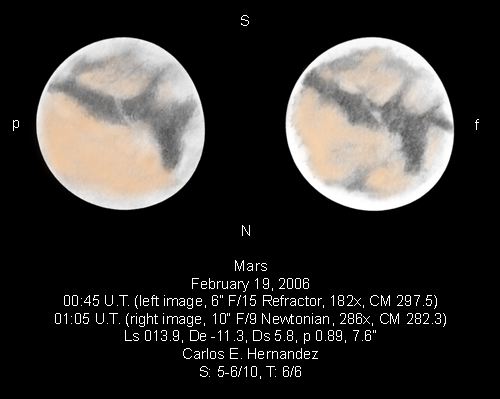
I made a pair of observations of Mars on February 19, 2006 (00:45 and 01:05 U.T.) using two excellent instruments (6" F/15 Refractor and a 10" F/9 Newtonian) belonging to a friend (Michael Palermiti, Jupiter, Florida). The apparent diameter of the planet was small (7.6"), but I was able to pick out detail when the seeing steadied for brief moments at a time. The red planet stills continue to provide views for us earthlings. I welcome any comments on my observations.
Date (U.T.): February 19, 2006
Time (U.T.): 00:45 (left image) and 01:05 (right image)
CM: 297.5 (left image) and 282.3 (right image)
Ls: 013.9 (Early Northern Spring/Southern Autumn)
De: -11.3, Ds: 5.8, p 0.89, 7.6"
Instrument: 6" F/15 Refractor (left image) and 10" F/9 Newtonian (right image)
Filters: None
Seeing (1-10): 5-6, Antoniadi (I-V): III
Transparency (1-6): 6
Notes:
00:45 U.T. (Left image, CM 297.5, 6" F/15 Refractor): Mare Cimmerium appears dark to dusky (3-4/10) preceding the CM. Hesperia appears as a light (7/10) division between Mare Cimmerium and Mare Tyrrhenum. Mare Tyrrhenum and Syrtis Minor appears dark to dusky (3-4/10) following the CM. Mare Chronium appears dusky (4/10) preceding the CM towards the South-preceding limb. Eridania and Ausonia appear shaded to bright (6-7/10). Mare Hadriacum appears dark to dusky (3-4/10) over the eastern (preceding) border of Hellas (8-9/10). Iapygia Viridis appears dusky (4/10) and Syrtis Major dark to dusky (3-4/10) towards the following limb. Aeolis and Aethiopis appears bright (7/10). Libya appears bright to very bright (7-8/10, haze?). Very bright to extremely bright (8-9/10) haze is visible over the south polar, preceding (evening), north polar, and following (morning) limbs.
01:05 U.T. (Right image, CM 282.3, 10" F/9 Newtonian): The above description (00:45 U.T.) applies to this observation with the addition of a greater clarity of albedo features. The Hyblaeus Extension (4-5/10) was visible towards the northern limb. The preceding (eastern) portions of Hellespontus (4/10) and Sabaeus Sinus (3/10) were visible over the following limb.
The best of luck in your own imaging and observations of Mars.
Regards,
Carlos E. Hernandez
Date (U.T.): February 19, 2006
Time (U.T.): 00:45 (left image) and 01:05 (right image)
CM: 297.5 (left image) and 282.3 (right image)
Ls: 013.9 (Early Northern Spring/Southern Autumn)
De: -11.3, Ds: 5.8, p 0.89, 7.6"
Instrument: 6" F/15 Refractor (left image) and 10" F/9 Newtonian (right image)
Filters: None
Seeing (1-10): 5-6, Antoniadi (I-V): III
Transparency (1-6): 6
Notes:
00:45 U.T. (Left image, CM 297.5, 6" F/15 Refractor): Mare Cimmerium appears dark to dusky (3-4/10) preceding the CM. Hesperia appears as a light (7/10) division between Mare Cimmerium and Mare Tyrrhenum. Mare Tyrrhenum and Syrtis Minor appears dark to dusky (3-4/10) following the CM. Mare Chronium appears dusky (4/10) preceding the CM towards the South-preceding limb. Eridania and Ausonia appear shaded to bright (6-7/10). Mare Hadriacum appears dark to dusky (3-4/10) over the eastern (preceding) border of Hellas (8-9/10). Iapygia Viridis appears dusky (4/10) and Syrtis Major dark to dusky (3-4/10) towards the following limb. Aeolis and Aethiopis appears bright (7/10). Libya appears bright to very bright (7-8/10, haze?). Very bright to extremely bright (8-9/10) haze is visible over the south polar, preceding (evening), north polar, and following (morning) limbs.
01:05 U.T. (Right image, CM 282.3, 10" F/9 Newtonian): The above description (00:45 U.T.) applies to this observation with the addition of a greater clarity of albedo features. The Hyblaeus Extension (4-5/10) was visible towards the northern limb. The preceding (eastern) portions of Hellespontus (4/10) and Sabaeus Sinus (3/10) were visible over the following limb.
The best of luck in your own imaging and observations of Mars.
Regards,
Carlos E. Hernandez
Attached Image:
