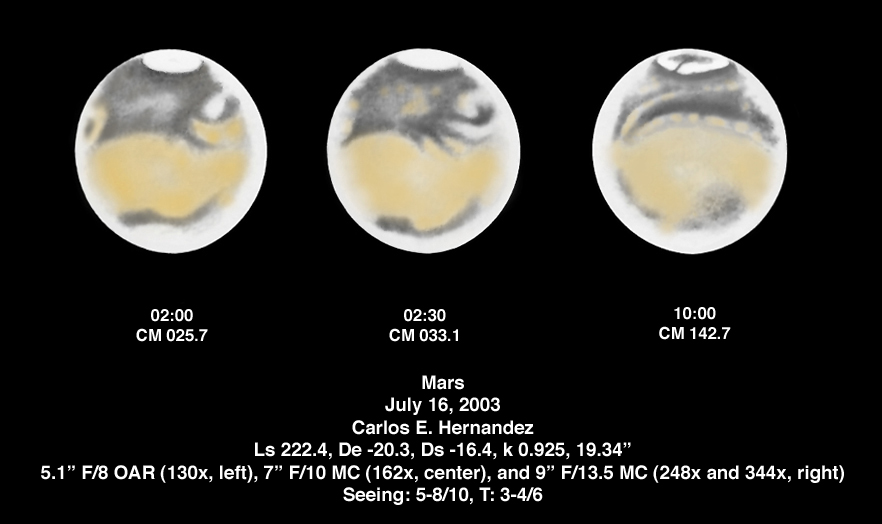

I made a series of Mars observations on this date using different instruments. The observations were made at a friend's observatory (Michael Palermiti, a noted optical designer and imager in Jupiter, Florida) using his 5.1" F/8 Off-Axis Parabolic reflector (a unique design which produces images equivalent to a high quality Apo refractor) and Intes Micro Alter M703 7" F/10 Maksutov-Cassegrain (first-rate optics) as well as my own custom 9" F/13.5 Maksutov-Cassegrain (built for me by Michael Palermiti). The seeing started as average (5-6/10) then later improved to good (7-8/10), fortunately while using the 9" F/13.5 Maksuov-Cassegrain. The following are my notes on the observations.
Left image:
Date (U.T.): July 16, 2003
Time (U.T.): 02:00
CM: 025.7
Ls 222.4, De -20.4, Ds -16.4, k 0.925, 19.34"
Instrument: 5.1" F/8 Off-Axis Parabolic Reflector
Magnification: 130x
Filter: None
Seeing (1-10): 5-6, Antoniadi (I-V): III
Transparency (1-6): 3 (Intermittent clouds)
Notes:
The South Polar Cap (SPC) appeared brilliant (10/10), but no detail visible within. Mare Australe appeared as a dark (3/10) collar surrounding the SPC. Margaritifer Sinus appeared dark (3/10) towards the preceding (evening) limb adjacent to an extremely bright (9/10) evening limb haze (ELH). Mare Erythraeum appeared dark to dusky (3-4/10) with a dull to shaded (5-6/10) core (Protei Regio/Pyrrhae Regio?). Aurorae Sinus appeared dark (3/10) following the CM whereas a dusky (4/10) projection was noted along the northern border of Mare Erythraeum preceding it. Agathodaemon (Coprates) appeared as a thin, dark (3/10) projection from the NW corner of Mare Erythraeum. Bosporos Gemmatus appeared dark (3/10) with a thin, dusky (4/10) Nectar noted to project from it's following border connected a dark (3/10) Solis Lacus. Chryse-Xanthe appeared bright (7/10) without any detail visible within. Niliacus Lacus appears as a dark (3/10) wedge adjacent to an extremely bright (9/10) northern limb haze (NLH) connected a dusky (4/10) Nilokeras. An extremely bright (9/10) morning (following) limb haze is noted as well.
Continued