
I was having a difficult time sleeping last night and went out around 2:00, earlier than ideal for Mars but I figured it would be high enough. While setting up, I realized that it was still REALLY HOT outside for being so late. Also, the sky was very murky; for example, only three of the stars in Cassiopeia's "M" shape were visible! Still, I've had really good planetary views under such conditions and so I continued setting up.
As usual, I set up the camera first to get the picture taken care of so I would be able to relax with the view after. The first view on the computer screen was discouraging, as the resulting picture here demonstrates. That's too bad, because Sinus Sabaeus and Meridiani are potentially rather photogenic.
The good news was that the visual impression was at least as good as that seen by the camera, which is hardly ever the case. The north polar hood's blue cast was obvious, the outline of the south polar cap was clearly delineated, the limb brightening clearly yellow, and Mare Erythraeum showed a notably darker area near it's center. I started with 14mm Plossls in the binoviewer (about 270x) and moved up to 11mm Plossls (about 360x). Knowing that Sabaeus was crossing my view, I tried really hard to detect it visually but to no avail.
By 4:00, I was sufficiently wet with sweat and ready to try getting some sleep, and so packed up. With visions of Mars in my head, I ended up being awake until 5:00, making work today more than a little challenging!
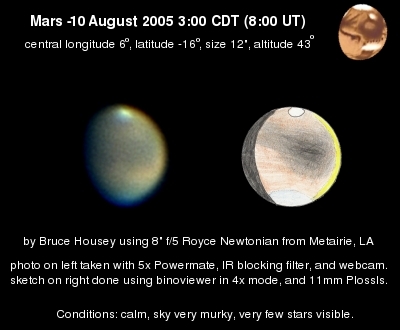
As usual, I set up the camera first to get the picture taken care of so I would be able to relax with the view after. The first view on the computer screen was discouraging, as the resulting picture here demonstrates. That's too bad, because Sinus Sabaeus and Meridiani are potentially rather photogenic.
The good news was that the visual impression was at least as good as that seen by the camera, which is hardly ever the case. The north polar hood's blue cast was obvious, the outline of the south polar cap was clearly delineated, the limb brightening clearly yellow, and Mare Erythraeum showed a notably darker area near it's center. I started with 14mm Plossls in the binoviewer (about 270x) and moved up to 11mm Plossls (about 360x). Knowing that Sabaeus was crossing my view, I tried really hard to detect it visually but to no avail.
By 4:00, I was sufficiently wet with sweat and ready to try getting some sleep, and so packed up. With visions of Mars in my head, I ended up being awake until 5:00, making work today more than a little challenging!
Attached Image:


