Image of the day

Captured by
Douglas Rollain

SH2-157_Seestar_S30_Pro

My Account

New to Astromart?

Register an account...

Need Help?

Question re Jupiter moons

Started by GregDamiani, 03/22/2003 06:32AM
Posted 03/22/2003 06:32AM Opening Post
I was observing Jupiter Friday night through Saturday morning (3/21 - 3/22). Three Gallilean moons were aligned on one side, another on the opposite side. I could not tell whether it was Europa or Ganymede by itself. I noticed between Io and the next moon (Europa or Ganymede) a very faint point of light, obviously in the plane of the moons and planet. This small faint light was closer to Io and stayed in the plane of the planet and moons, athough the distance between Io and this small faint light increased during my veiwing. This object was not noticably visible as a discreet disk.

Was this another moon?

I first noticed it at about 128X. After noticing it, it was clearly visible at 47X. I am using a Meade AR 6 (achromatic refractor).

Thank you.
Posted 03/22/2003 08:06AM #1
Hi, Gregory.
Ganymede was the lone satellite you saw opposite Io, Europa (two innermost), and Callisto. Jupiter's "lesser" moons are much, much smaller and fainter -- unfortunately beyond the grasp of most visual telescopes. Amalthea is an oblong moon (rocky asteroid-like body), less than 300km along its major axis. Its separation from Jupiter is only ~1 second of arc, so it is *extremely* difficult to see (and rarely seen). Barnard found it in 1902, using the 36-inch Lick refractor.

Not sure which star you saw between Io and Europa, but I'm hopeful that someone will be able to verify that info for you.

Did you enjoy a wider view of both Jupiter and M44 (the Beehive cluster) as well? Binoculars, with their lower magnifications and wide fields, should provide a splendid view of the big cluster and the giant planet. Jupiter will continue to nudge "closer" to M44 over the next few weeks and will remain within ~2 degrees of the cluster through the month of April.

Best wishes.
-Dan
Posted 03/23/2003 05:11AM #2
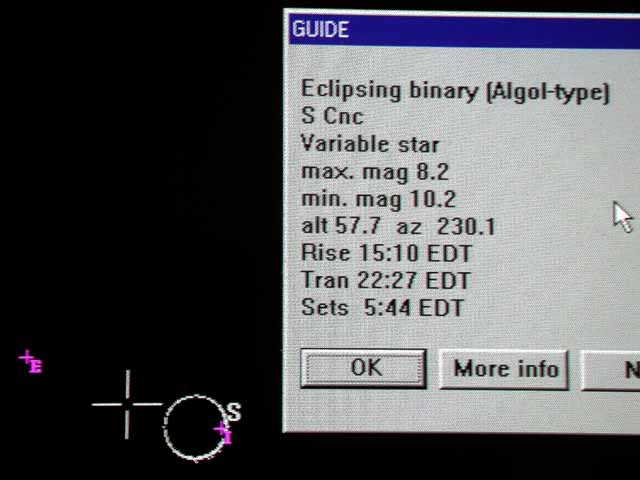
This is what Guide says!

Attached Image:

J.P. McBride's attachment for post 66020