
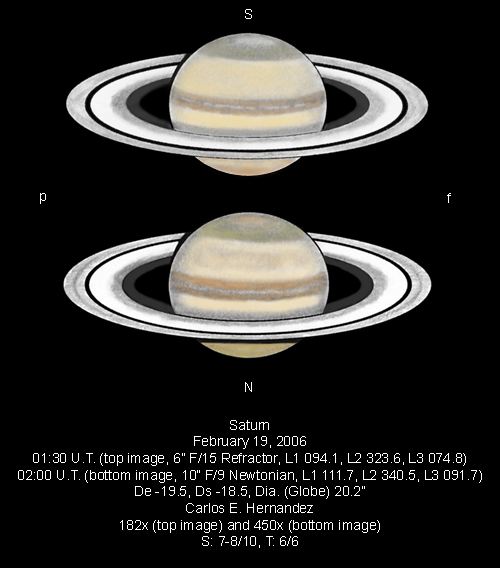
I made a pair of Saturn observations on February 19, 2006 (01:30 and 02:00 U.T,) using two excellent instruments (6" F/15 Refractor and a 10" F/9 Newtonian) belonging to a friend (Michael Palermiti, Jupiter, Florida). The amount of detail visible over the globe and rings was difficult to render. I welcome any comments that you may have on my observations.
Date (U.T.): February 19, 2006
Time (U.T.) 01:30 (top image) and 02:00 (bottom image)
Top Image: L1 094.1, L2 323.6, L3 074.8
Bottom Image: L1 111.7, L2 340.5, L3 091.7
De: -19.5, Ds: -18.5, Dia. (Globe): 20.2"
Instrument: 6" F/15 Refractor (top image) and 10" F/9 Newtonian (bottom image)
Magnification: 182x (top image) and 450x (bottom image)
Filters: None
Seeing (1-10): 7-8, Antoniadi (I-V): II
Transparency (1-6): 6
Notes:
01:30 U.T. (Top image, L1 094.1, L2 323.6, L3 074.8, 6" F/15 Refractor): The South Polar Region (SPR) appeared to consist of a tan-colored center surrounded by a light pastel olive-green collar (it's northern border appeared darker). The region between the South Temperate Zone (STZ) and the South Tropical Zone (STrZ) appeared a yellow mustard color and mottled (especially during very steady seeing). The South Equatorial Belt (SEB) appeared light to dark brown in color with a thin, bright zone dividing the belt into two components (SEB-N and SEB-S). The Equatorial Zone (EZ) appeared a light yellow mustard color, but no other detail visible within. The North Polar Region (NPR) appeared tan colored.
Ring A: Appeared shaded (6/10) and with hints of the Encke Minima visible (not always held).
Ring B: The inner half of the ring was dusky (4/10) whereas the outer half was bright (7/10).
Ring C (Crepe): Appeared dusky and thin.
02:00 U.T. (Right image, L1 111.7, L2 340.5, L3 091.7, 10" F/9 Newtonian): The above description (01:30 U.T.) is applicable to this one, but the features noted were easier to resolve. A truly spectacular sight!
The best of luck imaging and observing the ringed planet.
Regards,
Carlos E. Hernandez
P.S. The shadow of the globe on the rings should be over the right side of the planet instead of the left. I flipped it around while scanning.
Date (U.T.): February 19, 2006
Time (U.T.) 01:30 (top image) and 02:00 (bottom image)
Top Image: L1 094.1, L2 323.6, L3 074.8
Bottom Image: L1 111.7, L2 340.5, L3 091.7
De: -19.5, Ds: -18.5, Dia. (Globe): 20.2"
Instrument: 6" F/15 Refractor (top image) and 10" F/9 Newtonian (bottom image)
Magnification: 182x (top image) and 450x (bottom image)
Filters: None
Seeing (1-10): 7-8, Antoniadi (I-V): II
Transparency (1-6): 6
Notes:
01:30 U.T. (Top image, L1 094.1, L2 323.6, L3 074.8, 6" F/15 Refractor): The South Polar Region (SPR) appeared to consist of a tan-colored center surrounded by a light pastel olive-green collar (it's northern border appeared darker). The region between the South Temperate Zone (STZ) and the South Tropical Zone (STrZ) appeared a yellow mustard color and mottled (especially during very steady seeing). The South Equatorial Belt (SEB) appeared light to dark brown in color with a thin, bright zone dividing the belt into two components (SEB-N and SEB-S). The Equatorial Zone (EZ) appeared a light yellow mustard color, but no other detail visible within. The North Polar Region (NPR) appeared tan colored.
Ring A: Appeared shaded (6/10) and with hints of the Encke Minima visible (not always held).
Ring B: The inner half of the ring was dusky (4/10) whereas the outer half was bright (7/10).
Ring C (Crepe): Appeared dusky and thin.
02:00 U.T. (Right image, L1 111.7, L2 340.5, L3 091.7, 10" F/9 Newtonian): The above description (01:30 U.T.) is applicable to this one, but the features noted were easier to resolve. A truly spectacular sight!
The best of luck imaging and observing the ringed planet.
Regards,
Carlos E. Hernandez
P.S. The shadow of the globe on the rings should be over the right side of the planet instead of the left. I flipped it around while scanning.
Attached Image:
