
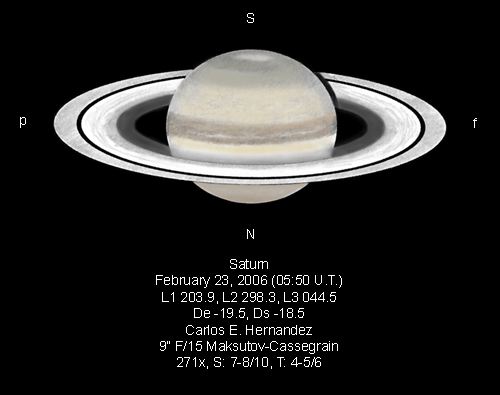
I made an observation of Saturn on February 23, 2006 at 05:50 U.T. under good seeing conditions (7-8/10). The globe and rings exhibited a significant amount of detail as shown. I welcome any comments that you may have on my observation.
Date (U.T.): February 23, 2006
Time (U.T.) 05:50
Top Image: L1 203.9, L2 298.3, L3 044.5
De: -19.6, Ds: -18.5, Dia. (Globe): 20.2"
Instrument: 9-inch (23-cm) F/13.5 Maksutov-Cassegrain
Magnification: 271x
Filters: None
Seeing (1-10): 7-8, Antoniadi (I-V): II
Transparency (1-6): 4-5
Notes:
05:50 U.T. (L1 203.9, L2 298.3, L3 044.5): The South Polar Region (SPR) appeared to consist of a tan-colored center surrounded by a light pastel olive-green collar. The region between the South Temperate Zone (STZ) and the South Tropical Zone (STrZ) appeared a yellow mustard color and mottled (especially during very steady seeing). The South Equatorial Belt (SEB) appeared light to dark brown in color with a thin, bright (7/10) zone dividing the belt into two components (SEB-N and SEB-S). The Equatorial Zone (EZ) appeared bright (7/10, a light yellow mustard color), but no other detail visible within. The North Polar Region (NPR) appeared tan colored.
Ring A: Appeared shaded (6/10), but no other detail noted within.
Ring B: The inner half of the ring was dusky (4/10) whereas the outer half was bright (7/10). Thin, dull (5/10) divisions were noted over the outer half.
Ring C (Crepe): Appeared dusky (4/10) and transparent.
The best of luck imaging and observing the ringed planet.
Regards,
Carlos E. Hernandez
Date (U.T.): February 23, 2006
Time (U.T.) 05:50
Top Image: L1 203.9, L2 298.3, L3 044.5
De: -19.6, Ds: -18.5, Dia. (Globe): 20.2"
Instrument: 9-inch (23-cm) F/13.5 Maksutov-Cassegrain
Magnification: 271x
Filters: None
Seeing (1-10): 7-8, Antoniadi (I-V): II
Transparency (1-6): 4-5
Notes:
05:50 U.T. (L1 203.9, L2 298.3, L3 044.5): The South Polar Region (SPR) appeared to consist of a tan-colored center surrounded by a light pastel olive-green collar. The region between the South Temperate Zone (STZ) and the South Tropical Zone (STrZ) appeared a yellow mustard color and mottled (especially during very steady seeing). The South Equatorial Belt (SEB) appeared light to dark brown in color with a thin, bright (7/10) zone dividing the belt into two components (SEB-N and SEB-S). The Equatorial Zone (EZ) appeared bright (7/10, a light yellow mustard color), but no other detail visible within. The North Polar Region (NPR) appeared tan colored.
Ring A: Appeared shaded (6/10), but no other detail noted within.
Ring B: The inner half of the ring was dusky (4/10) whereas the outer half was bright (7/10). Thin, dull (5/10) divisions were noted over the outer half.
Ring C (Crepe): Appeared dusky (4/10) and transparent.
The best of luck imaging and observing the ringed planet.
Regards,
Carlos E. Hernandez
Attached Image:
