
The period of July 16-22, 1994 was a very exciting one for all that witnessed the planet Jupiter's southern hemisphere barraged by fragments of a ruptured comet. It began for me, and a few other fortunate friends including Jeff Beish and Don Parker, with the impact of the first fragment (A or 21) on July 16, 194 (20:11 U.T.). Ironically I had lectured a few months earlier, as was believed at the time, that little was to be observed from the impacts of the fragments of S-L 9 except for possibly a small faint bright cloud visible only in large instruments (>12 inches aperture). How wrong I was! The impact of the first fragment (A or 21) started a show that was witnessed by many observers around the world (and in space, the HST) for a period of six days. Here are some of my observations of this incredible event.
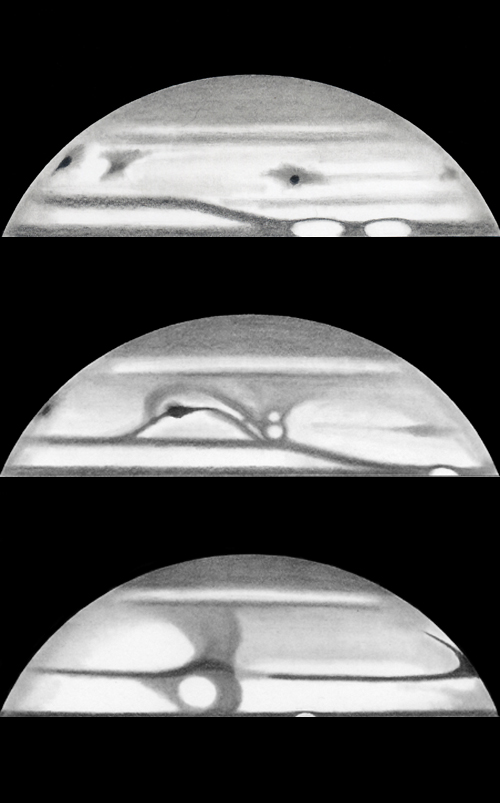
The sectional observation of Jupiter's southern hemisphere on top was made on July 19, 1994 at 01:25 U.T. (L1 080.6. L2 139.4, L3 210.0) using a 16-inch F/6.9 Newtonian at 360x (S: 8/10, T: 5/9). The S-L 9 impact sites (number designation; date and time of impact) observed, from preceding to following (or left to right), are E (17; July 17, 1994 at 15:11 U.T.), A (21; July 16, 1994 at 20:11 U.T.), and C (19: July 17, 1994 at 07:12 U.T.). The E impact site is visible on the preceding limb with it's dusky ejecta towards the southeast. The A impact site is now beginning to lighten in intensity and become more diffuse after it's initial impact three days earlier. The C impact site is visible just following the CM as a dark nodule surrounded by a dusky elongated fan-shaped ejecta towards the south. The South South Temperate Belt (SSTB) is visibly deviated towards the south preceding the CM. Two large bright ovals are visible within the South Temperate Belt (STB) following the CM.
The middle observation was made on July 31, 1994 at 00:20 U.T. (L1 134.0, L2 101.6. and L3 175.4) using a 16-inch F/6.9 Newtonian at 382x (S: 7-8/10, T: 6/6). The impact site of H ( 14: July 18, 1994 at 19:31:59 U.T.) is visible as a dark nodule with a dusky collar on the preceding limb. The E impact site is now visible as an elongated dark albedo feature with dark projections along it's preceding and following borders (it's ejecta is now elongated and curved to the south as well). The A impact site has now developed into a diffuse dark area with two small, bright ovals within it. The C impact site is now visible as a dull, elongated albedo feature towards the following limb.
The bottom observation was made on August 31, 1994 at 00:45 U.T. (L1 358.2, L2 089.1, and L3 171.4) using an 8-inch F/7.5 Newtonian at 213x and 285x (S: 5/10 (periods of 7), T: 5/6). The E impact site is now visible as a dark, curvilinear streak with a dusky diffuse column extending south from it's southern border. A large bright oval appears to the north of the E impact site within the South Temperate Zone (STZ) enclosed by dusky material. The preceding half of the K (12; July 19, 1994 at 10:24:14 U.T.) impact site is visible on the following limb as a dark condensation with a southern projection. Impact sites A and C are no longer visible.
I hope to describe more S-L 9 observations soon. I hope that you enjoy this flashback.
Regards,
Carlos E. Hernandez
The sectional observation of Jupiter's southern hemisphere on top was made on July 19, 1994 at 01:25 U.T. (L1 080.6. L2 139.4, L3 210.0) using a 16-inch F/6.9 Newtonian at 360x (S: 8/10, T: 5/9). The S-L 9 impact sites (number designation; date and time of impact) observed, from preceding to following (or left to right), are E (17; July 17, 1994 at 15:11 U.T.), A (21; July 16, 1994 at 20:11 U.T.), and C (19: July 17, 1994 at 07:12 U.T.). The E impact site is visible on the preceding limb with it's dusky ejecta towards the southeast. The A impact site is now beginning to lighten in intensity and become more diffuse after it's initial impact three days earlier. The C impact site is visible just following the CM as a dark nodule surrounded by a dusky elongated fan-shaped ejecta towards the south. The South South Temperate Belt (SSTB) is visibly deviated towards the south preceding the CM. Two large bright ovals are visible within the South Temperate Belt (STB) following the CM.
The middle observation was made on July 31, 1994 at 00:20 U.T. (L1 134.0, L2 101.6. and L3 175.4) using a 16-inch F/6.9 Newtonian at 382x (S: 7-8/10, T: 6/6). The impact site of H ( 14: July 18, 1994 at 19:31:59 U.T.) is visible as a dark nodule with a dusky collar on the preceding limb. The E impact site is now visible as an elongated dark albedo feature with dark projections along it's preceding and following borders (it's ejecta is now elongated and curved to the south as well). The A impact site has now developed into a diffuse dark area with two small, bright ovals within it. The C impact site is now visible as a dull, elongated albedo feature towards the following limb.
The bottom observation was made on August 31, 1994 at 00:45 U.T. (L1 358.2, L2 089.1, and L3 171.4) using an 8-inch F/7.5 Newtonian at 213x and 285x (S: 5/10 (periods of 7), T: 5/6). The E impact site is now visible as a dark, curvilinear streak with a dusky diffuse column extending south from it's southern border. A large bright oval appears to the north of the E impact site within the South Temperate Zone (STZ) enclosed by dusky material. The preceding half of the K (12; July 19, 1994 at 10:24:14 U.T.) impact site is visible on the following limb as a dark condensation with a southern projection. Impact sites A and C are no longer visible.
I hope to describe more S-L 9 observations soon. I hope that you enjoy this flashback.
Regards,
Carlos E. Hernandez
Attached Image:
