Image of the day

Captured by
Byron Davies

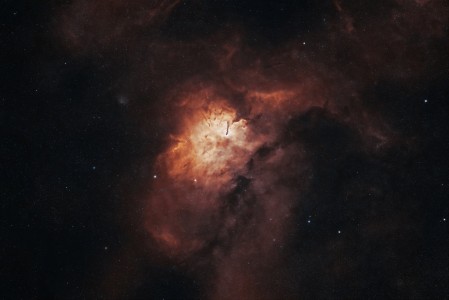
Sh2-86 (NGC-6820)

My Account

New to Astromart?

Register an account...

Need Help?

Solar Projecting Viewer

Started by Alex McConahay, 04/05/2011 12:57AM
Posted 04/05/2011 12:57AM Opening Post
Short form: Can I make a solar projection setup out of just about any telescope?

I mean without burning up the tube or eyepiece.

Long Form:

I have a real nice solar setup with rear projection. Works great.

I made it out of my first telescope, a 60 mm Bushnell. Cause I figure if it burned up, I did not care all that much.

Well, I was thinking of upgrading to one of my "real" scopes. I have several tubes that could be candidates. But before I let an unfiltered sun go through them, I want to know about some issues----

I have no concerns about safety. I designed this to use around kids. One would have to go way out of his or her way to get into a position where they could see the unfiltered sun. (And I have hundreds of hours working outreaches with elementary school kids and others--so I am really not worried.)

I am mostly concerned about my equipment, heat buildup, etc.

Is there any problem with just letting the sun go right through a sealed-tube refractor or SCT/Mak with a nice eyepiece? I imagine there is some heat buildup, but since the surfaces are reflective or transparent, it is not as if I am sticking a piece of paper (or an ant) at the focal point. I have not noticed any heat problems with my old Bushnell, but, well I am still reluctant to try it out with a good (expensive) scope.

What is your experience?

Alex
Posted 04/05/2011 10:43AM | Edited 04/05/2011 10:45AM #1
Alex, I used a 10" f/5.6 Newt for that purpose for a long time when I taught Astronomy. I used an ancient "army surplus" eyepiece, and could project an image 10" or 12" across onto a shaded screen. The eyepiece would be my only concern, although I never noticed my old eyepiece getting hot. When I would do this for a class, I would blacken a small piece of paper with pencil lead, and hold it near the eyepiece when pointing toward the sun. It would immediately catch fire, demonstrating the need to keep eyes away from there! Once (and only once) I was giving a brief introductory talk about what we were doing, with the scope pointing away from the Sun. One of the kids piped up with "Hey Mr. Mathis, should smoke be coming out of the telescope?"...turns out that I wasn't point quite far enough away from the Sun, and the light was hitting the inside of scope. No actual fire, but... 8)

Steve
Posted 04/05/2011 03:14PM #2
Steve's concerns are very valid.

On axis, the sun's power may traverse the scope's optics without issue. If it gets off axis in an SCT it could cause significant damage to the secondary mounting or the baffle tubes and any optical surface adjacent. If it gets off axis in a Newt or refractor it can make an eyepiece too hot to touch and it can start a fire depending on the tube structure. There are lots of pics of sun damage from unattended Newts.

You can use a very long focus lens to project an image of the sun. The aperature and focal length can be chosen so the sun's image is the same diameter as the lens. In that way, there is never a point in the path where the optical energy is concentrated above what it is in the open sunshine.

dan
Posted 04/06/2011 10:19PM #3
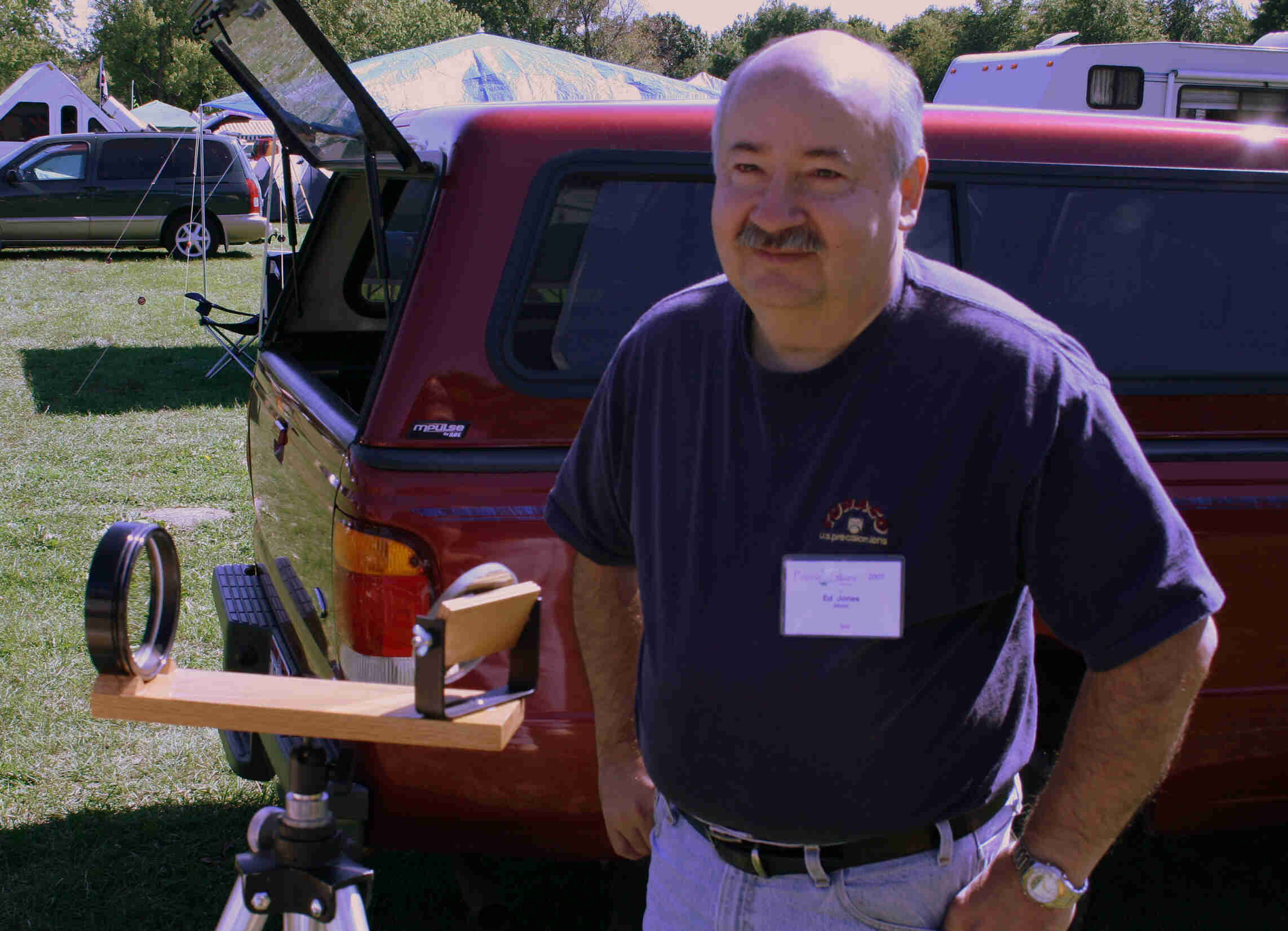
My favorite projector is this one made by Ed Jones. It employs something like an f/50 lens and a large flat attached to a board. Simple and safe...the f ratio is so long that you really can't get burned. The flat rotates to catch the sun and put it through the lens. I have mounted it on my Losmandy G8 so I can track. I place a large white board on an easel at the focal point, yards away, and it provides a rather large easy to see image of the sun and sunspots.

Attached Image:

swsands's attachment for post 140368
Posted 04/07/2011 06:12PM #4
"Is there any problem just ... with a nice eyepiece?"

Apparently yes:
from "Solar Astronomy Handbook," Beck, Hilbrecht, et.al., Willmann-Bell, Inc., Richmond, Va, 1995. pg 15:
"A.2.1 Solar Projection Screen
A solar projection screen enables the observers to see sunspots and faculae (see A.1and Fig. A.1.1) in absolute safety. It is also the simplest method of observation. Heat can build up in a telescope that projects the sun and therefore cemented eyepieces should never be used - use only Huygens, Mittenzwey, or Ramsden eyepieces. The owner of a telescope having a cemented objective mounted in a black cell should cover the black areas with reflecting aluminum coated Mylar to dissipate the heat. Even with these precautions prolonged observations of the sun can cause the cement between lens elements to melt, thereby damaging the objective."

John
Posted 04/08/2011 12:01AM #5
I may be mistaken, but, back when I was about 11 years old, I seem to recall projecting the sun's image and observing sunspots with my toy reflector with the eyepiece removed. I think I tried it both ways. The focal length was very different of course, but I recall the images being pretty comparable. If this is true, then maybe you don't need to risk an eyepiece at all?
Posted 04/10/2011 01:10AM #6
My solar viewer was out all day, and had about 500 attendees at the outreach.

Nothing burned.

Of course nobody was all that excited with the whitish circle, and two little specks.

Alex
Posted 04/10/2011 06:26PM #7
By the way--what is the source of the material used for the projection "Screen?"

I use a piece of rear projector screen I got as a sample--but is there something better? Where can I obtain it? Come to think of it, where does one find rear-projection screen material in general?

Alex