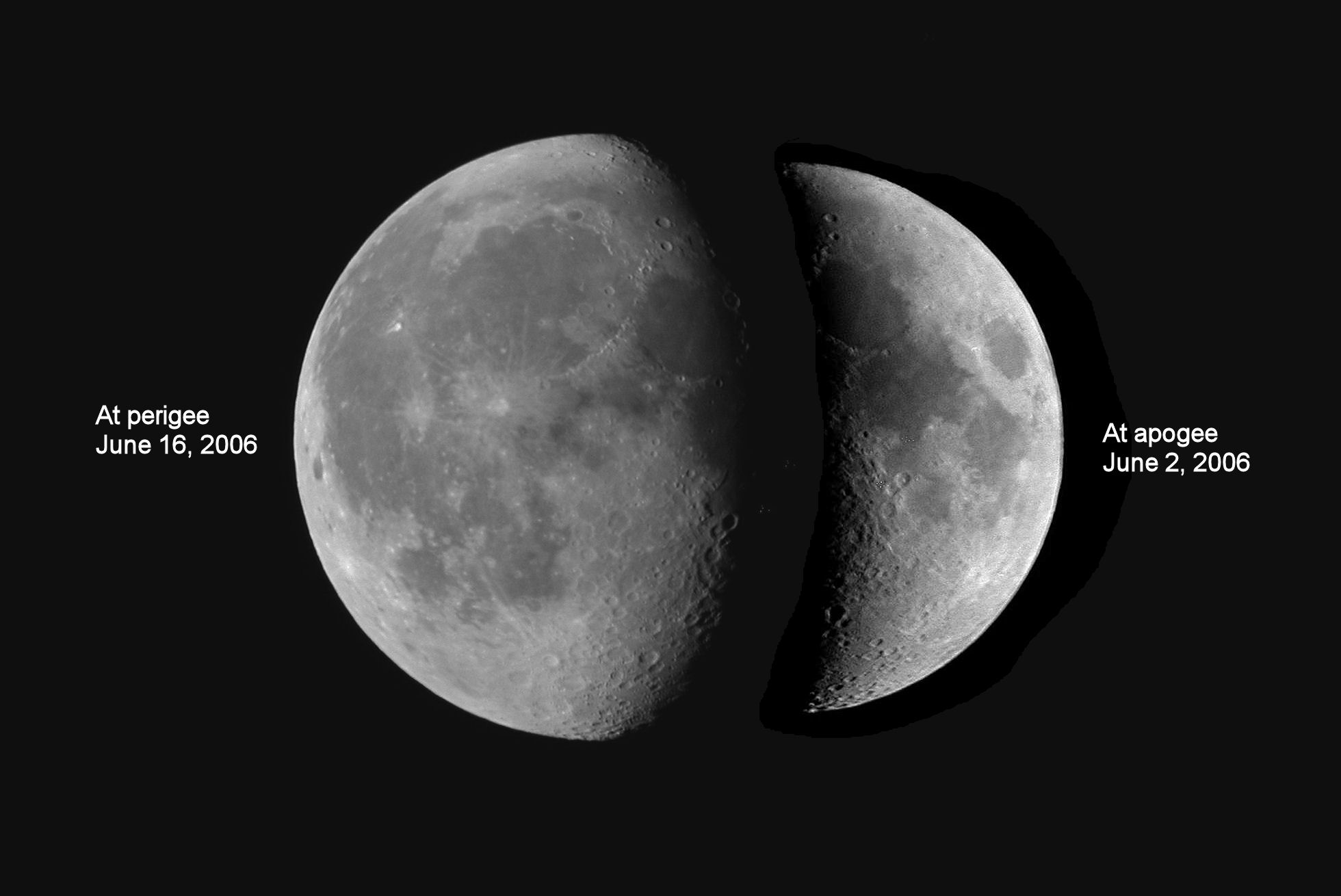

The Full Moons in August, September and October of 2006 will appear unusually large due to their occurrences nearly coinciding with perigee. These three perigees will all be especially close ones of less than 360,000 km (some perigees are over 370,000 km.) Apogees are all between 404,000 km and 407,000 km.
A Full Moon at extreme perigee can appear as much as 14% wider than one at extreme apogee. The angular surface area of the apparent lunar disk, and therefore its total brightness, can be 30% greater. The distance to the Sun is a brightness consideration but a much lesser one.
Full Moon (geocentric opposition in ecliptical longitude)
AUG 09 10:54 UT 361,257 km
SEP 07 18:42 UT 357,295 km
OCT 07 03:13 UT 357,696 km
Full Moon (time of greatest illumination for Chicago - geocentric distance)
AUG 09 13:10 UT 361,049 km
SEP 07 18:44 UT 357,295 km
OCT 07 02:23 UT 357,661 km
Perigee (geocentric)
AUG 10 18:35 UT 359,752 km
SEP 08 02:52 UT 357,177 km
OCT 06 14:16 UT 357,415 km
The September Full Moon will be partially eclipsed with 17.8% of its diameter covered at 18:51 UT. Unfortunately, the event won’t be visible in the Americas.
Since the 2006 Autumnal Equinox will occur almost exactly midway between the September and October Full Moons, either one could be referred to as the Harvest Moon. Although the October one has a slightly better claim to the title.
Enjoy the spectacle of each of this year’s late summer and early autumn Full Moons. If you take photographs, they would be welcome additions to this thread.
For astronomical graphics, including
monthly wallpaper calendar, visit:
CurtRenz.com/astronomical
Curt Renz