
The transit was a definite Wow! from St. Louis, Missouri.
We had cloudy/rainy weather predicted for several days
before and after June 8 and the entire show would be over
50 minutes after sunrise. So, I was not optimistic about
actually seeing this. A few of our club's members traveled
hundreds of miles to the east to get a better view. Here in
St. Louis, the entire event would be done 50 minutes after sunrise.
Not having the time to travel very far, I settled on trying to
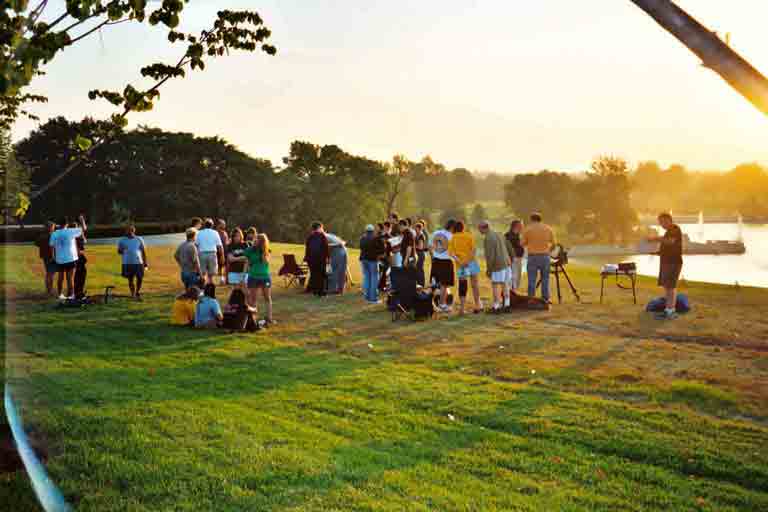
observe it from St. Louis. I found a good spot in front of the
city's Art Museum in the large city park we have here in
St. Louis - and it was a very pretty setting at this location
on the slopes of "Art Hill"
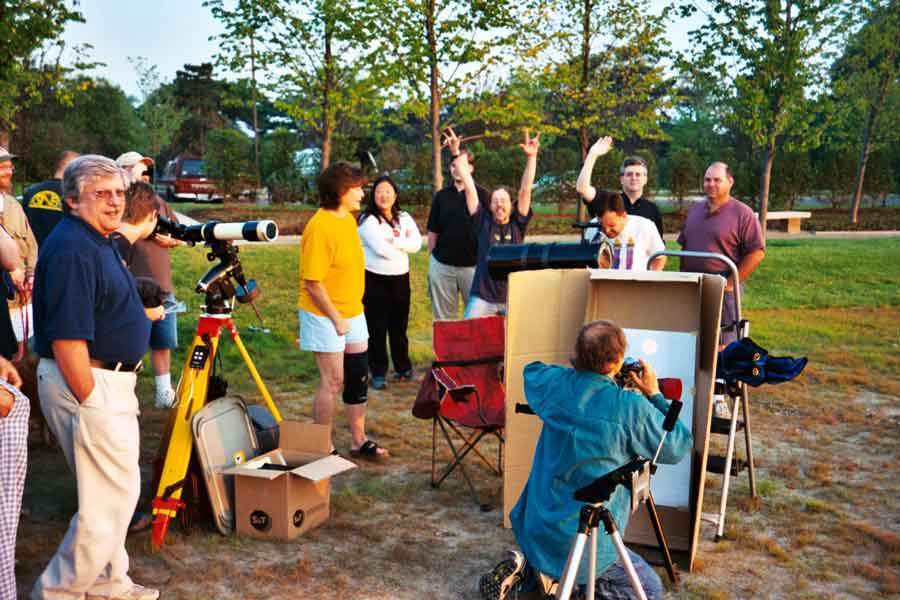
I was one of the last people with equipment to show
up. We had several about 8 club members show up and
some additional friends, along with 20-30 non-members.
Where they came from, I'm not sure. A couple of them said
they were just in the 'hood. But since we had at least 4 scopes
with filters for direct observing and my 80mm finder
for group image projection everyone had plenty of viewing chances.
Even though I arrived later than I wanted to, I still
had plenty of time to set up all my equipment - the
jury rigged 80mm finder sun projector and my equatorially
mounted 76mm Televue filtered refractor - and enjoy
the spectacle of a nice summer pre-dawn sky from a
pleasant location. Everyone seemed to be in a relaxed
mood and we were able to enjoy each other's company as
much as the anticipation of the upcoming sunrise and
transit. I think the non-members were enjoying the
light atmosphere, too.
Once the sun's disk cleared the trees and low lying
clouds its brilliance was still attenuated enough to
allow a brief naked eye peak at the spectacle of the
disk of Venus superimposed on the sun. I couldn’t see
anything in the filtered scope at that point but that didn’t
surprise me. I think I recall someone ( a club member, I think)
shouting something about how he didn't expect it to be
so noticeable to the unaided eye (I wasn't either). It
was a fantastic site!
Not too long after that it became too bright for
direct unfiltered viewing I had no problem finding it
in the filtered refractor and getting the projected
image to provide a nice view. Two sunspots close to
the center of the sun's disk were visible in the
filtered view, but not in the projected image.
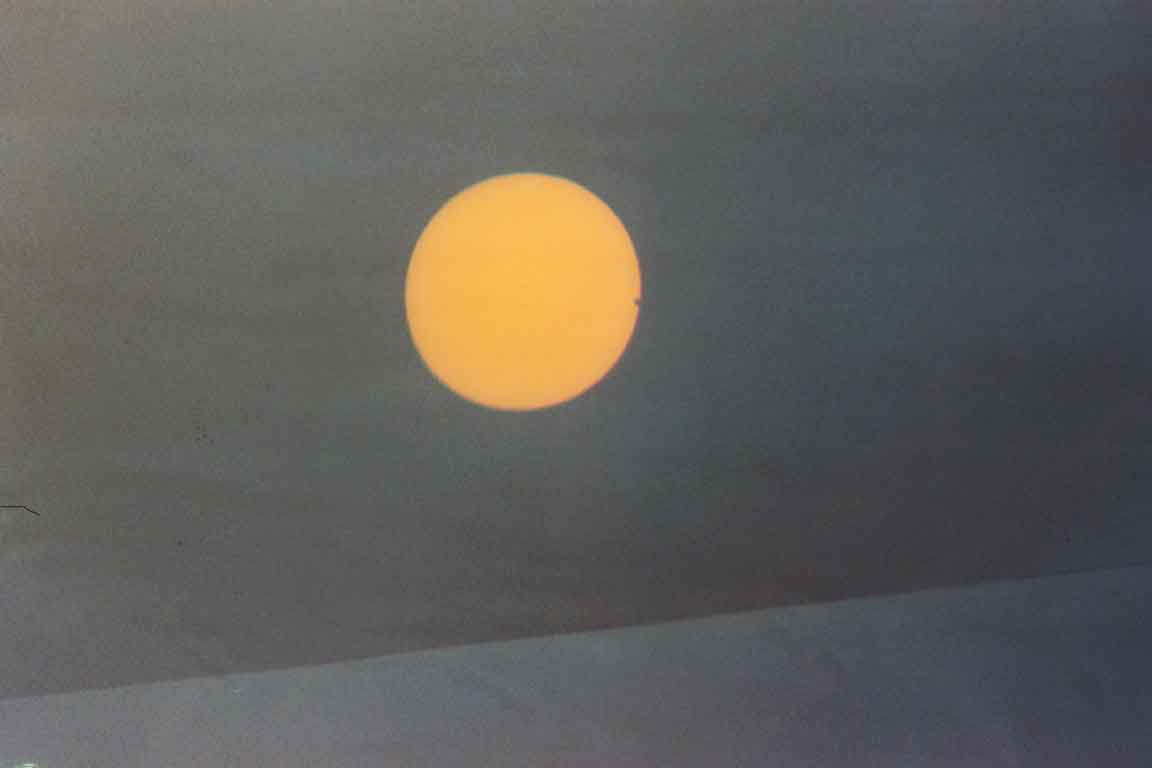
However, the black disk of Venus was unmistakable in
both. At all times we had about a half dozen people
looking at the projected image. With the number of
filtered scopes set up, everyone that showed up was
able to get many turns at the eyepiece.
We had cloudy/rainy weather predicted for several days
before and after June 8 and the entire show would be over
50 minutes after sunrise. So, I was not optimistic about
actually seeing this. A few of our club's members traveled
hundreds of miles to the east to get a better view. Here in
St. Louis, the entire event would be done 50 minutes after sunrise.
Not having the time to travel very far, I settled on trying to
observe it from St. Louis. I found a good spot in front of the
city's Art Museum in the large city park we have here in
St. Louis - and it was a very pretty setting at this location
on the slopes of "Art Hill"
I was one of the last people with equipment to show
up. We had several about 8 club members show up and
some additional friends, along with 20-30 non-members.
Where they came from, I'm not sure. A couple of them said
they were just in the 'hood. But since we had at least 4 scopes
with filters for direct observing and my 80mm finder
for group image projection everyone had plenty of viewing chances.
Even though I arrived later than I wanted to, I still
had plenty of time to set up all my equipment - the
jury rigged 80mm finder sun projector and my equatorially
mounted 76mm Televue filtered refractor - and enjoy
the spectacle of a nice summer pre-dawn sky from a
pleasant location. Everyone seemed to be in a relaxed
mood and we were able to enjoy each other's company as
much as the anticipation of the upcoming sunrise and
transit. I think the non-members were enjoying the
light atmosphere, too.
Once the sun's disk cleared the trees and low lying
clouds its brilliance was still attenuated enough to
allow a brief naked eye peak at the spectacle of the
disk of Venus superimposed on the sun. I couldn’t see
anything in the filtered scope at that point but that didn’t
surprise me. I think I recall someone ( a club member, I think)
shouting something about how he didn't expect it to be
so noticeable to the unaided eye (I wasn't either). It
was a fantastic site!
Not too long after that it became too bright for
direct unfiltered viewing I had no problem finding it
in the filtered refractor and getting the projected
image to provide a nice view. Two sunspots close to
the center of the sun's disk were visible in the
filtered view, but not in the projected image.
However, the black disk of Venus was unmistakable in
both. At all times we had about a half dozen people
looking at the projected image. With the number of
filtered scopes set up, everyone that showed up was
able to get many turns at the eyepiece.
Attached Image: