

During my last visit to California, I noticed something new outside the San Jose Airport Terminal; Solar Trash Cans. Having lived the last 30+ years in podunk Boise, Idaho, I had never seen one of these marvels of modern technology.
After several minutes of staring at it like it was some type of being from another world and taking a cell phone picture of it (attached), I finally surmised (correctly) that it was some type of solar powered trash compactor. I also assumed (correctly) that its intended purpose is to reduce the number of times it required a visit by a human being to empty it, thereby saving money and probably putting one or more non-English speaking workers out of work. (I wonder if Hilda Solis knows about this yet.)
At first they seemed to be a good idea, until I spent some time thinking about it. I finally got around to doing a little research on this new invention and here's what I learned.
1. They cost around $3500 to $4000 each and the San Jose airport has a bunch of them. This must be part of the reason for the ridiculous fees added to airline fares and car rentals at the airport.
2. They require special "compactor" bags, as opposed to regular trash bags, which surely cost more.
3. Since they require exposure to sunlight to operate, they must be placed out in the open and not under awnings, overhangs or between buildings. This means that in a pouring rain, you have to get drenched in order to dispose of your trash.
4. The rechargeable battery hidden inside is supposed to require replacement every 3~5 years. In reality, we all know that rechargeable batteries only last half as long as they're supposed to, are always of some unique design and are expensive.
5. Being much more technically complex than a traditional trash can, these solar trash cans require maintenance and repair by a specially trained and competent human, equipped with a van, tools and replacement parts. You can bet that isn't cheap.
6. Because of their high initial cost, several large cities have replaced many regular trash cans in public areas with only a few solar trash cans. The result is that since it's harder to find a trash can when you need one, more trash ends up on the street.
7. New York City prematurely ended its trial with solar trash cans after too many complaints from people who put mail into them, only to find out later they were not mail boxes. (Once you put something into it, you can't retrieve it.) Can you imagine mistakenly putting your State and Federal Tax Returns into a solar trash can? And why New York?
Although I couldn't find a documented incident, it's only a matter of time before some lady's diamond ring will fall off her finger while disposing of a Starbucks cup or a guy will lose his gold Rolex GMT II in the same manner.
So, whaddaya think about solar trash cans?
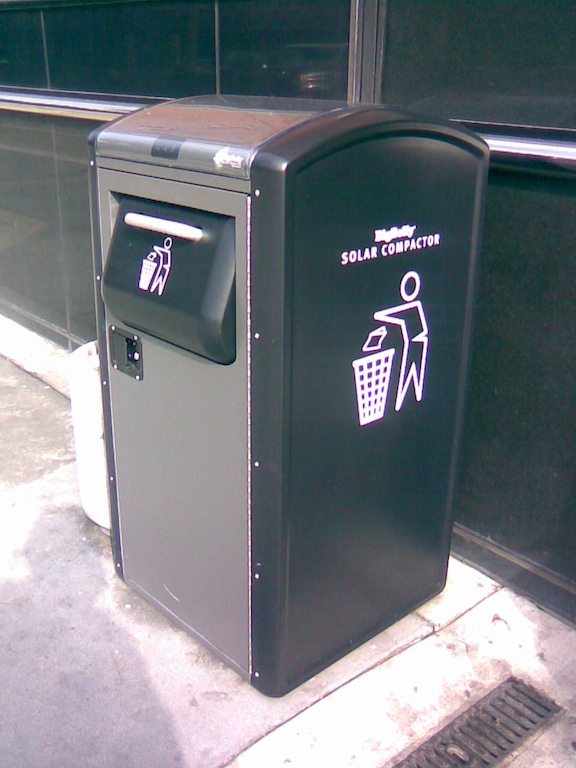
After several minutes of staring at it like it was some type of being from another world and taking a cell phone picture of it (attached), I finally surmised (correctly) that it was some type of solar powered trash compactor. I also assumed (correctly) that its intended purpose is to reduce the number of times it required a visit by a human being to empty it, thereby saving money and probably putting one or more non-English speaking workers out of work. (I wonder if Hilda Solis knows about this yet.)
At first they seemed to be a good idea, until I spent some time thinking about it. I finally got around to doing a little research on this new invention and here's what I learned.
1. They cost around $3500 to $4000 each and the San Jose airport has a bunch of them. This must be part of the reason for the ridiculous fees added to airline fares and car rentals at the airport.
2. They require special "compactor" bags, as opposed to regular trash bags, which surely cost more.
3. Since they require exposure to sunlight to operate, they must be placed out in the open and not under awnings, overhangs or between buildings. This means that in a pouring rain, you have to get drenched in order to dispose of your trash.
4. The rechargeable battery hidden inside is supposed to require replacement every 3~5 years. In reality, we all know that rechargeable batteries only last half as long as they're supposed to, are always of some unique design and are expensive.
5. Being much more technically complex than a traditional trash can, these solar trash cans require maintenance and repair by a specially trained and competent human, equipped with a van, tools and replacement parts. You can bet that isn't cheap.
6. Because of their high initial cost, several large cities have replaced many regular trash cans in public areas with only a few solar trash cans. The result is that since it's harder to find a trash can when you need one, more trash ends up on the street.
7. New York City prematurely ended its trial with solar trash cans after too many complaints from people who put mail into them, only to find out later they were not mail boxes. (Once you put something into it, you can't retrieve it.) Can you imagine mistakenly putting your State and Federal Tax Returns into a solar trash can? And why New York?
Although I couldn't find a documented incident, it's only a matter of time before some lady's diamond ring will fall off her finger while disposing of a Starbucks cup or a guy will lose his gold Rolex GMT II in the same manner.
So, whaddaya think about solar trash cans?
Attached Image:

