
Hi All,
Testing resolution limits at my site last week, I did some experiments to see how pixel scale affects max resolution. I had seen improvements in the past on small faint objects like the Einstein Cross when I increased my pixel scale.
Amateurs usually opt for faster focal ratios in the belief that it will increase their signal/noise ratio. They also sometimes bin their color data, i.e. shoot the luminance at 1x1 and the color at 2x2, thinking that the luminance will compensate for the lower resolution color data. Sometimes that works when the seeing is not very good, but even under not so great seeing, shooting at 2x2 does degrade the results.
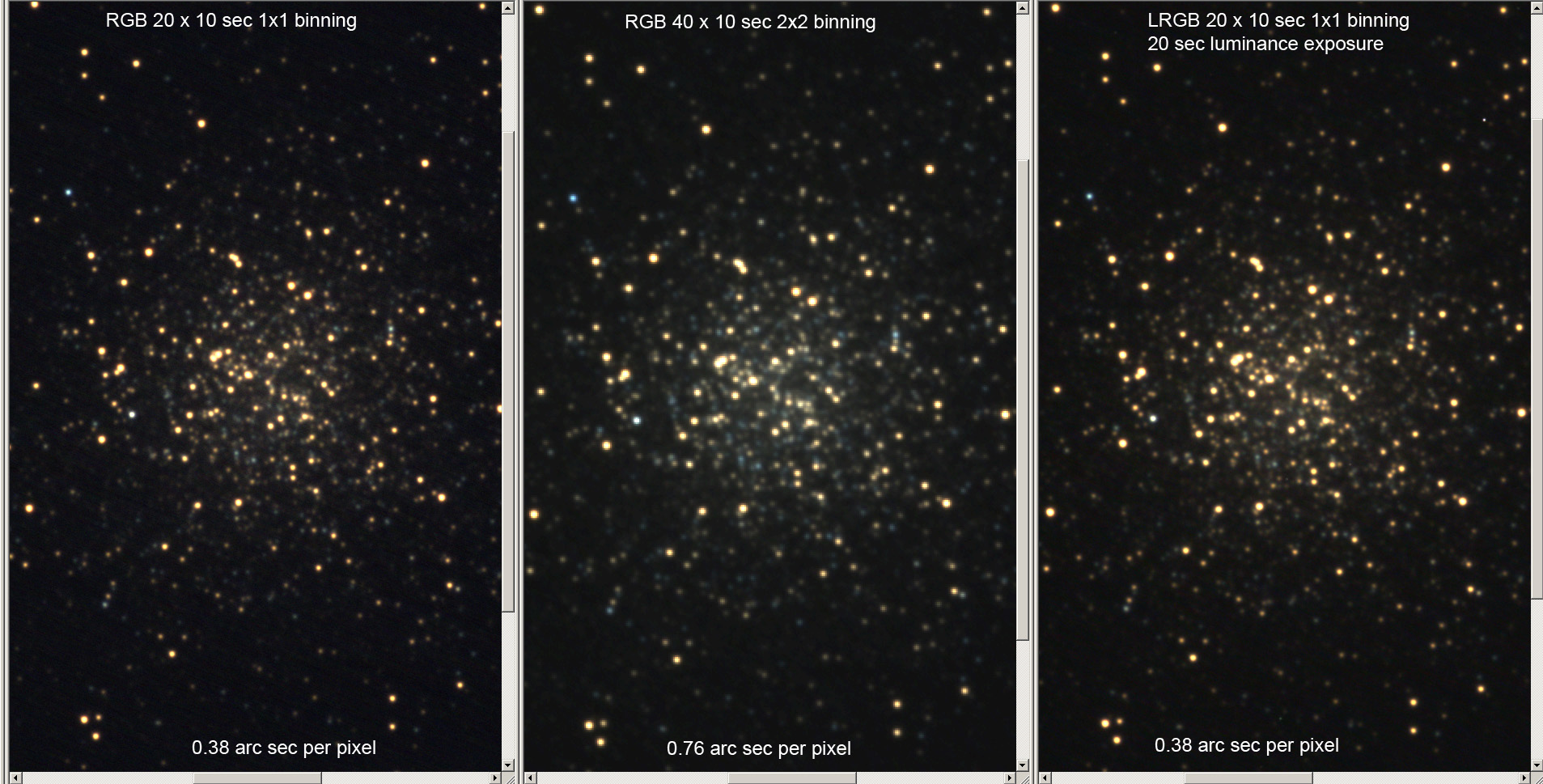
Attached are 3 shots of the core of M13 compared side by side. All shots were taken with my 12" Mak-Cass and ST10XE camera. I stacked an number of short 10 second unguided exposures.
#1 shows pure RGB taken at 1x1 binning. #2 shows 2x2 binning, twice as many exposures in an effort to get better signal/noise. #3 shows the original 1x1 RGB with 20 seconds of luminance added.
Result as you can see, the pure RGB has the highest resolution. You can see many faint stars that are washed out in the 2x2 RGB. Even though the 2x2 binned image has less background noise, and it is twice the length exposure (giving theoretically 4x better signal/noise) it does not have better signal. There are fainter stars in the 1x1 image. The third image shows how adding just a short luminance set (two 10 sec L exposures) improves the background noise dramatically and preserves the resolution.
I like to use the four stars in the short arc on the right side of the core as a guide to the resolution of the core. These images have not been sharpened or processed except for stacking.
Rolando
Testing resolution limits at my site last week, I did some experiments to see how pixel scale affects max resolution. I had seen improvements in the past on small faint objects like the Einstein Cross when I increased my pixel scale.
Amateurs usually opt for faster focal ratios in the belief that it will increase their signal/noise ratio. They also sometimes bin their color data, i.e. shoot the luminance at 1x1 and the color at 2x2, thinking that the luminance will compensate for the lower resolution color data. Sometimes that works when the seeing is not very good, but even under not so great seeing, shooting at 2x2 does degrade the results.
Attached are 3 shots of the core of M13 compared side by side. All shots were taken with my 12" Mak-Cass and ST10XE camera. I stacked an number of short 10 second unguided exposures.
#1 shows pure RGB taken at 1x1 binning. #2 shows 2x2 binning, twice as many exposures in an effort to get better signal/noise. #3 shows the original 1x1 RGB with 20 seconds of luminance added.
Result as you can see, the pure RGB has the highest resolution. You can see many faint stars that are washed out in the 2x2 RGB. Even though the 2x2 binned image has less background noise, and it is twice the length exposure (giving theoretically 4x better signal/noise) it does not have better signal. There are fainter stars in the 1x1 image. The third image shows how adding just a short luminance set (two 10 sec L exposures) improves the background noise dramatically and preserves the resolution.
I like to use the four stars in the short arc on the right side of the core as a guide to the resolution of the core. These images have not been sharpened or processed except for stacking.
Rolando
Attached Image:

