

My real goal last night was to continue tweaking the autoguiding without resorting to a new guide scope. (And I was ready to move on from the Pelican's neck). Since this scope hadn't looked at the Bubble yet, that is where it ended up.
These were 10 minute subs (7 each of Ha=red and OIII=blue) which is better than previous attempts here. At least the oval stars were much less oval than the 5 minute subs a few weeks ago. There were a couple of subs that even looked really round! I think the collimation must still be funny, since the stretched stars had some very interesting shapes that didn't look like guiding problems.
[SII] should be soon? Hope the weather holds. This is really unusual for this time of year here.
Although I think the artifact around the bright star looks really cool, I would be very interested in ideas on how to get rid of it.
Thanks,
Charlie
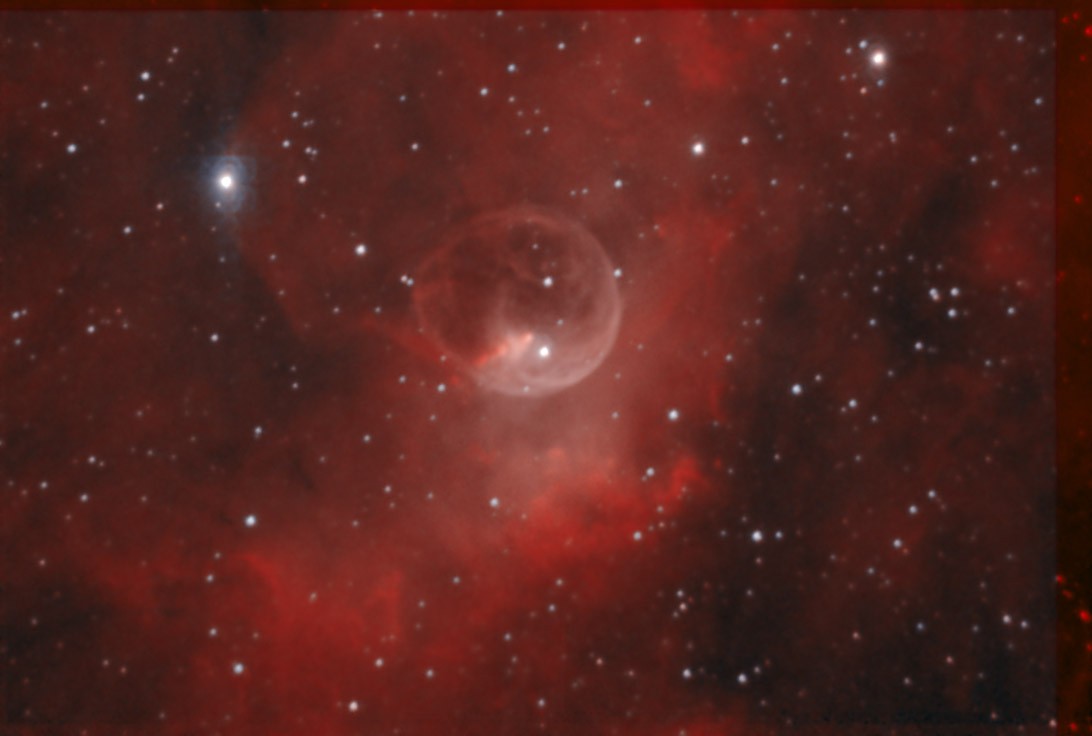
These were 10 minute subs (7 each of Ha=red and OIII=blue) which is better than previous attempts here. At least the oval stars were much less oval than the 5 minute subs a few weeks ago. There were a couple of subs that even looked really round! I think the collimation must still be funny, since the stretched stars had some very interesting shapes that didn't look like guiding problems.
[SII] should be soon? Hope the weather holds. This is really unusual for this time of year here.
Although I think the artifact around the bright star looks really cool, I would be very interested in ideas on how to get rid of it.
Thanks,
Charlie
Attached Image:
Fort Lewis Observatory: (37.238, -108.052) ~2360m (7744 ft.) elevation.
Darkness - typically 6.5+
Scope - Meade 16" LX200; f6.3 focal reducer
Focus - JMI Smart focus
Camera - SBIG ST-10XE; (~.5"/pixel)
Guiding - AO-8 and/or Meade 5"/DSI/PHD
http://www.fortlewis.edu/observatory
