Image of the day

Captured by
Erwin Forbragd

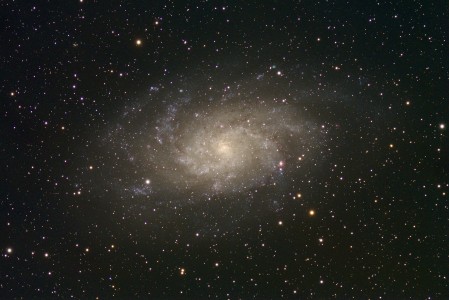
M33 in Triangulum

My Account

New to Astromart?

Register an account...

Need Help?

Canon Question

Started by Ibartman, 01/11/2007 04:52AM
Posted 01/11/2007 04:52AM Opening Post
Ok if i purchase a new Canon 300D or 350D and take pics of the night without making the modification of removing the filter over the chip ( i think that is what is done) what will it look like and will it work or not? Does it make any difference if i dont use the telescope and just use the camera lens? Thanks

Rick
Posted 01/11/2007 06:40PM #1
I'll let the experts answer your question about what you can/can't get without removing the IR filter. But, here are a few samples of what I have done with a standard 20d...

http://www.pbase.com/billhuegerich/astrophotography
Posted 01/13/2007 05:57PM #2
Yes, you can get excellent pictures either with or without the IR filter.

However, if there is something that is particularly rich in IR, most of that IR will be blocked if you leave the filter on. This will not only increase exposure times, but radically change the color balance.

As you know, many objects in the heavens do not have much in the way of IR. The moon, A planet, a typical star, and a distant galaxy are all pretty much full spectrum, white light, essentially. So, they won't change very much whether you have a filter or not. However, the dep sky things most people like to take pictures of, especially the bright nebulae of various sorts, tend to be rivh in IR. And you would miss much of this. In short--The results would really benefit from removing the IR filter.

If your favorite astrophotos are of things that have a lot of red or pink, then you would want to remove the filter because this is the infrared showing through.

Alex
Posted 01/13/2007 06:04PM #3
As for whether you use the telescope or the camera lens:

Theoretically, a telescope used with a camera is basically a very long telephoto lens on the camera. SO, no, in theory it does not matter. If you happen to have a camera lens with the same focal length and aperture as your telescope, it should be about the same. However, as I am sure you realize, very few camera lenses are as long as your typical telescope.

Practically, of course, the camera lens is generally optimized to act as a camera lens. It has an iris that will change the aperture, and is engineered (often) to be sharpest a stop or two below maximum aperture. It has a wider, flatter field than the typical telescope. And the image circle is made to cover the chip. It also has focusing mechanisms. Telescopes are not so engineered.

A shorter form of the answer--Your camera lens will probably have a much wider field and less magnification than the typical telescope.

Alex

Alex
