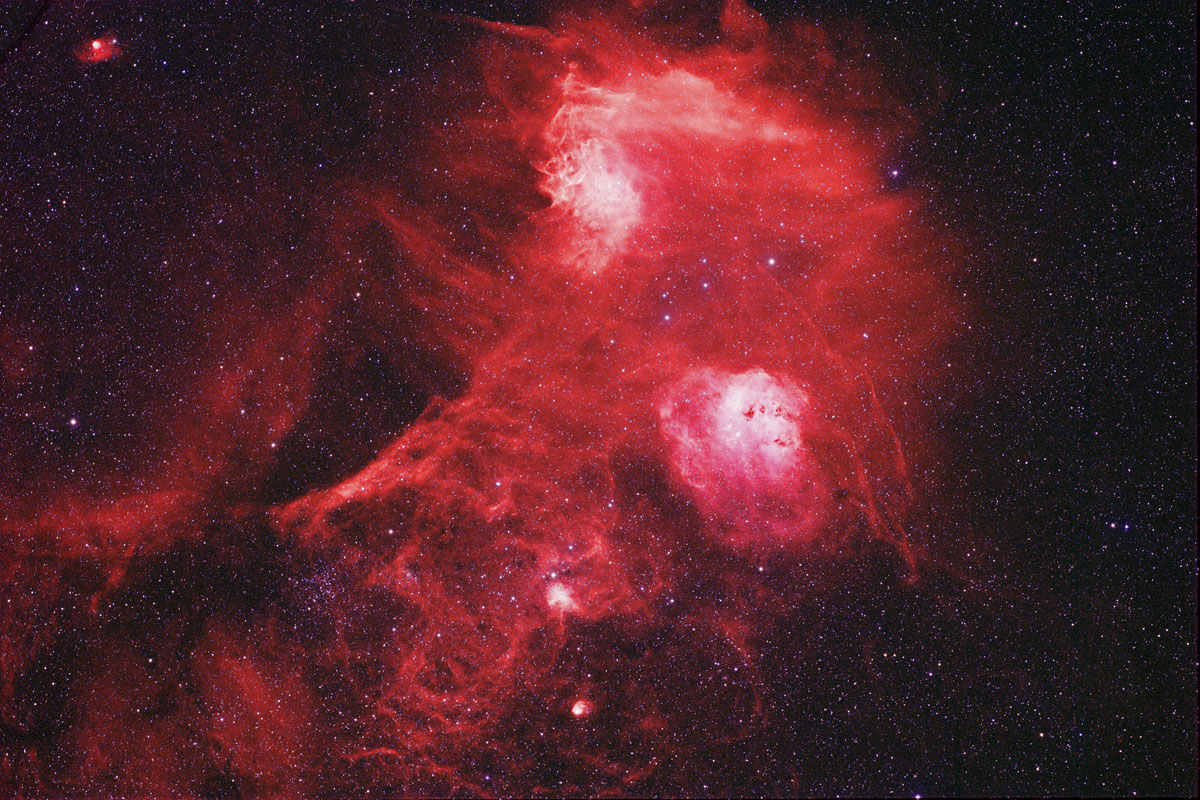
In the constellation of Auriga are some wonderful clusters and nebulae. This view looks along the galactic plane, near the direction of the galactic anticenter. This is a single 1200 second subframe using Hydrogen Alpha data and covers more than 12 Full Moons (6 degrees) on the sky with North to the left.
The field includes emission region Sh2-227 top left, IC 405 (top center) about 1,500 light-years distant. Also known as the Flaming Star Nebula, its Hydrogen Alpha convoluted clouds of glowing hydrogen gas are energized by hot O-type star AE Aurigae. Slightly to the below is M38.
IC 410 (below center slightly right) is significantly more distant, some 12,000 light-years away. The star forming region is famous for its embedded young star cluster, NGC 1893, and tadpole-shaped clouds of dust and gas. IC 417 and NGC 1931 at the lower right.
To the Bottom center are Sh2 232,LBN 805,LDN 1525, Sh2 231,LBN 803, LBN 802, Sh2 235, LBN 808, LBN797.
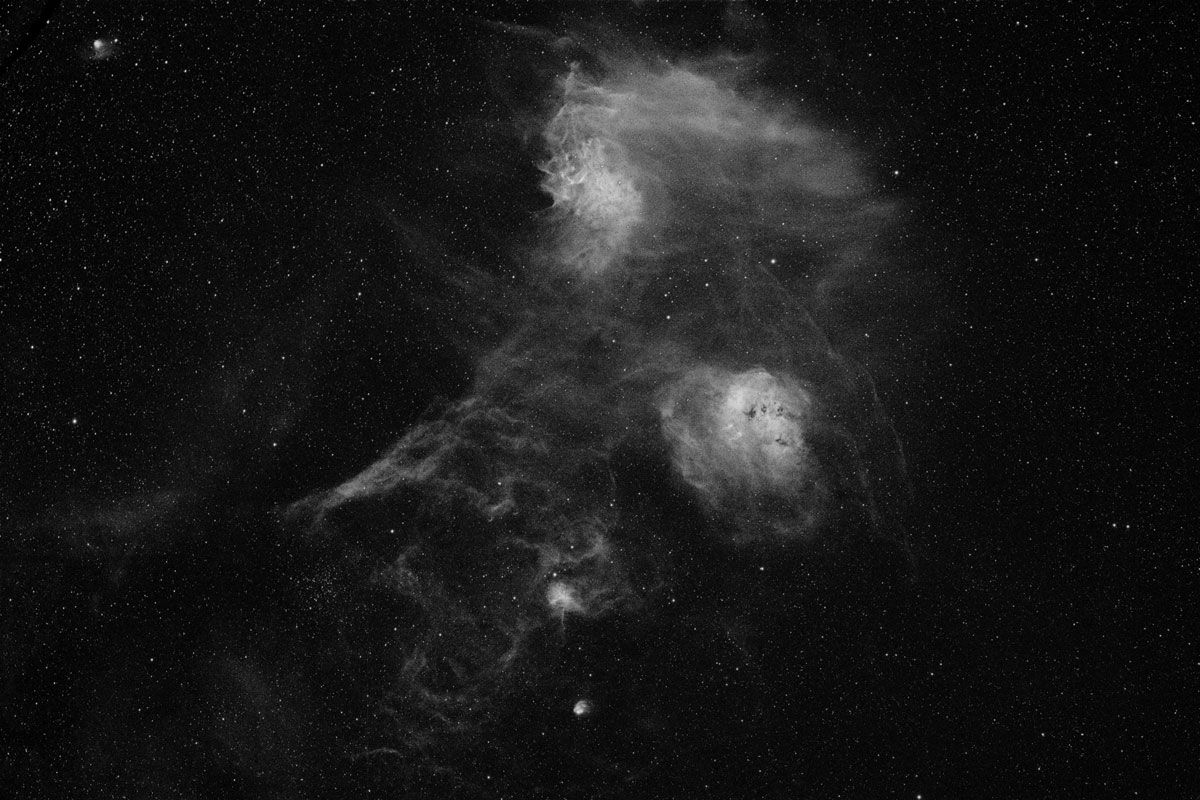
The field includes emission region Sh2-227 top left, IC 405 (top center) about 1,500 light-years distant. Also known as the Flaming Star Nebula, its Hydrogen Alpha convoluted clouds of glowing hydrogen gas are energized by hot O-type star AE Aurigae. Slightly to the below is M38.
IC 410 (below center slightly right) is significantly more distant, some 12,000 light-years away. The star forming region is famous for its embedded young star cluster, NGC 1893, and tadpole-shaped clouds of dust and gas. IC 417 and NGC 1931 at the lower right.
To the Bottom center are Sh2 232,LBN 805,LDN 1525, Sh2 231,LBN 803, LBN 802, Sh2 235, LBN 808, LBN797.
Attached Image: