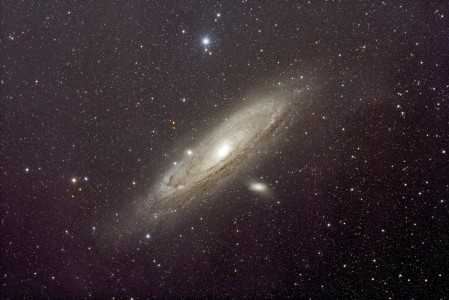

I'm imaging with Meade DSI Pro, using color filters. I take typically 40-50 images for luminance, the time of each exposure varies, based on how well my mount is performing that night, but usually 15 -25 seconds. Then I do the same for the RED, GREEN, AND BLUE images. Red always seems to dominate, and I have to adjust color during processing to get image to look like it should. MY QUESTION, IS THERE A RATIO OF WHAT PERCENTAGE OF IMAGES SHOULD GO TO EACH COLOR TO GET A BETTER LOOKING IMAGE? Should they be equal?
LRGB IMAGING
Started by squeege, 04/26/2006 11:25AM
Posted 04/26/2006 11:25AM
Opening Post
Posted 04/26/2006 01:21PM
#1
Mark,
There are really two answers to this that I know of. One I have experience with, the other will hopefully be answered by someone with greater experience.
1) Depending upon the angle of the object in the sky which you are shooting, each color filter will allow different amounts of light to get through. Straight up, all is pretty equal. But the lower in the sky you go, you begin to lose more blue than red to due to the increasing amount of atmosphere the photons pass through. Different wavelenghts get absorbed in different amounts. More atmosphere the greater the ratio between the colors. This is probably why you lean toward more red or, thought of differently, less blue. There are atmosperhic extinction charts that allow you to compensate for this--I use one by a terrific imager named Jon Talbot which I don't have here at work but can direct you to at once I'm home. (I got it posted on the Yahoo Starlight Xpress group.) This chart includes multipliers that enable you to compensate each color due to the loss at the angle you shot. The processing software I use, AstroArt3, lets me due this in post processing.
2) I understand that any manufacturer's set of filters will also have unique characteristics between the colors that can be measured and then compensated for, again in processing or in the duration you shoot each filter. I personally have never done this. I shoot all filters equally then use the process described above.
I hope this makes some kind of sense. I would highly recommend reading "The Handbook of Astronomical Image Processing" by Berry and Burrell to really get a handle on this, and pretty much all other topics relating to post processing. (Also comes with an excellent processing program, as well.)
One other thought--you can actually go less on the colors than on the luminance since all of your detail is in the lum. In fact, go as long as you possibly can for the luminance--a ratio I've seen that I tend to use is RGB added up to equal the lum. So a good ratio would be one hour than twenty minutes on each color, for example.
Again, hopefully someone with even more experience than myself will chime in here as well.
Regards,
Larry
Funding Member
