
I spent a bit of time setting up the gear for this one. William Optics 80/480 F6 TMB triplet fluorite. I found I was getting fairly colourless shots.
I set the white balance ot the Nikon D70 by imaging Alpha Centauri (a G2V star) and used that photo to set the white balance settings for the Nikon.
I experimented with and without the Baader UV/IR block out filter, with and without Celestron F6.3 reducer and found best results were:
90 seconds to 2 minutes unguided on MI 250.
With Baader UV/IR block. Native focal length at F6, white balance set to G2V star photo, ISO 1600, exposure compensation to 0, mode 3 exposures (turning off the camera after the shot with noise reduction on to "beat" the automatic median filter built-in to RAW mode in the Nikon).
Beautiful clear night in Sydney, high transparency and good seeing.
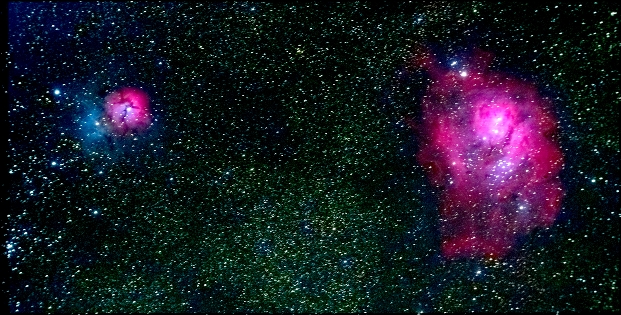
7 x 90 and 120 second shots. Shot heavily cropped, bit of coma at the edges that should be corrected by TV .8X flattener/reducer on the way.
This scope is starting to make me smile!! It is an ideal companion to the FS152.
Greg.
I set the white balance ot the Nikon D70 by imaging Alpha Centauri (a G2V star) and used that photo to set the white balance settings for the Nikon.
I experimented with and without the Baader UV/IR block out filter, with and without Celestron F6.3 reducer and found best results were:
90 seconds to 2 minutes unguided on MI 250.
With Baader UV/IR block. Native focal length at F6, white balance set to G2V star photo, ISO 1600, exposure compensation to 0, mode 3 exposures (turning off the camera after the shot with noise reduction on to "beat" the automatic median filter built-in to RAW mode in the Nikon).
Beautiful clear night in Sydney, high transparency and good seeing.
7 x 90 and 120 second shots. Shot heavily cropped, bit of coma at the edges that should be corrected by TV .8X flattener/reducer on the way.
This scope is starting to make me smile!! It is an ideal companion to the FS152.
Greg.
Attached Image:
