
Hello,
I've been working on an imaging project since last month. This isn't it
Last weekend we had an unexpected string of clear skies, and an invitation from a friend of mine to join him at his dark site could not be ignored.
In a quest for better focal length for higher-resolution imaging, I bought a Mewlon 210 a couple of years ago. To tame its focal length, I also bought an AP 0.67 telecompressor. Which did not come to focus with the scope. Adding insult to injury, last year I messed up the collimation of that scope and relegated it to the bench for a while.
This year, I made it a project to collimate this beast once and for all. Visually, it was very promising: I got to see the E and F components of the Trapezium the night I tweaked its collimation, something I've never seen with my 8" SCT's (well, the E on occasion, but never the F). I also got a lower-profile, sturdier focuser for the Mewlon: a Moonlite Crayford with a Robofocus-compatible stepper motor. To my delight, the Mewlon came to focus with the AP telecompressor and that focuser!
So here is my first shot with that combination. It's relatively shallow compared to my multi-night uber-sessions, but it was taken at a dark site, so I can't complain. It still needs some collimation tweaking, and the stars aren't perfect - either coma, collimation, tracking errors, or a combination of all. Stuff for me to work out over time.
NGC 4565
Takahashi Mewlon 210 with stepper-equipped Moonlite focuser
AP 0.67 Telecompressor
SBIG ST-8XE with Astrodon LRGB filters
Takahashi EM200 Temma 2
L: 14 x 10 minutes binned 1x1
RGB: 10 x 5 minutes each binned 2x2
I count myself lucky on a couple of additional points: I found a guide star with the camera's default position, and I was actually able to rotate the camera almost perfectly 180 degrees after the meridian flip!
Dawn cut my session short.
Enjoy, and comments and suggestions always welcome.
Eric
I've been working on an imaging project since last month. This isn't it
Last weekend we had an unexpected string of clear skies, and an invitation from a friend of mine to join him at his dark site could not be ignored.
In a quest for better focal length for higher-resolution imaging, I bought a Mewlon 210 a couple of years ago. To tame its focal length, I also bought an AP 0.67 telecompressor. Which did not come to focus with the scope. Adding insult to injury, last year I messed up the collimation of that scope and relegated it to the bench for a while.
This year, I made it a project to collimate this beast once and for all. Visually, it was very promising: I got to see the E and F components of the Trapezium the night I tweaked its collimation, something I've never seen with my 8" SCT's (well, the E on occasion, but never the F). I also got a lower-profile, sturdier focuser for the Mewlon: a Moonlite Crayford with a Robofocus-compatible stepper motor. To my delight, the Mewlon came to focus with the AP telecompressor and that focuser!
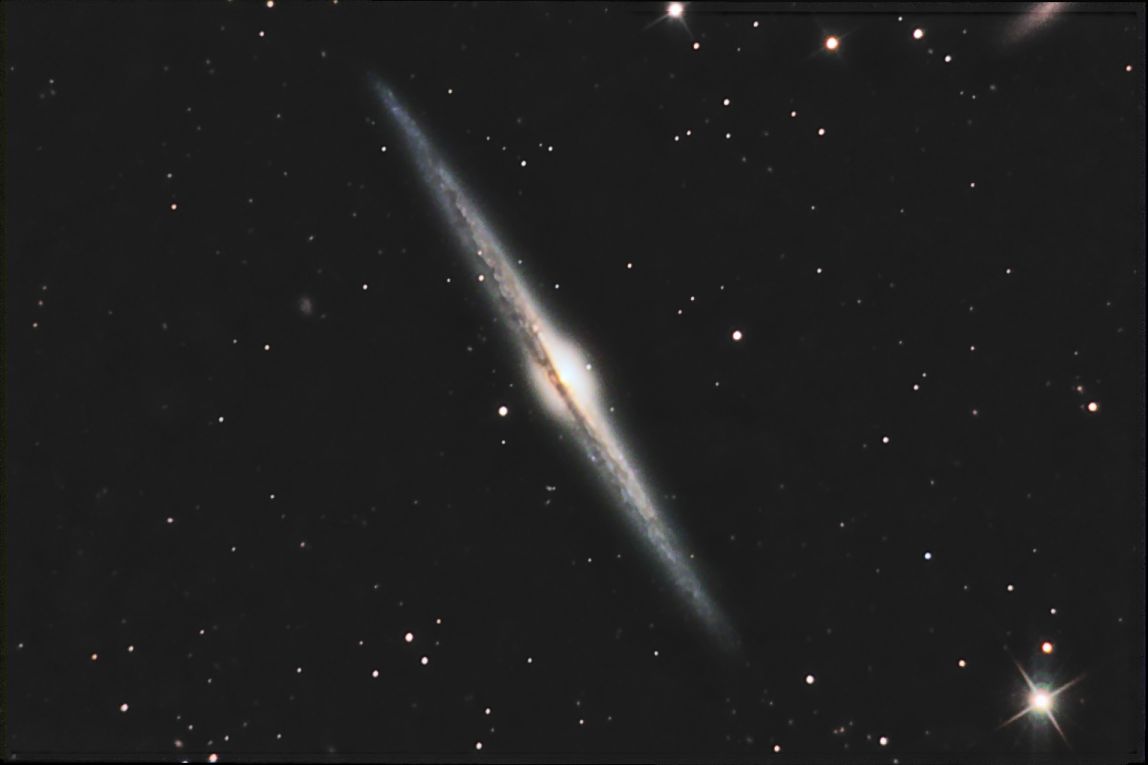
So here is my first shot with that combination. It's relatively shallow compared to my multi-night uber-sessions, but it was taken at a dark site, so I can't complain. It still needs some collimation tweaking, and the stars aren't perfect - either coma, collimation, tracking errors, or a combination of all. Stuff for me to work out over time.
NGC 4565
Takahashi Mewlon 210 with stepper-equipped Moonlite focuser
AP 0.67 Telecompressor
SBIG ST-8XE with Astrodon LRGB filters
Takahashi EM200 Temma 2
L: 14 x 10 minutes binned 1x1
RGB: 10 x 5 minutes each binned 2x2
I count myself lucky on a couple of additional points: I found a guide star with the camera's default position, and I was actually able to rotate the camera almost perfectly 180 degrees after the meridian flip!
Dawn cut my session short.
Enjoy, and comments and suggestions always welcome.
Eric
Attached Image:


