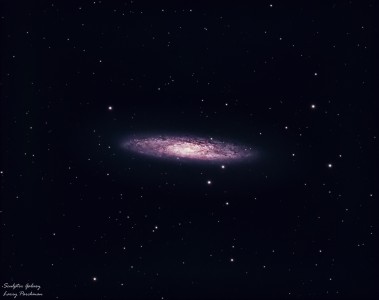

I started this image back in August. The most recent evening was almost a month ago now, but I never got around to processing it until this weekend. This is a total of 8 hours in 10 minute subs. L:R:G:B = 16:11:10:11. I was never very happy with the color ones - I am pretty sure the mount "knew" when one of the color filters was in and self-adjusted the tracking to be less good. :S I and am not sure I ever got a series as good as the first set - wish the scope could go longer on the subs, but not the way things are working right now. I tried processing the RGB with fewer, better, subs, but ended up using all that weren't awful.
Data acquisition with CCDSoft. Reduced and aligned in CCDStack. Subs combined in Sigma Beta. RGB combined in AstroArt at 1:1:1.5 ratio. Arcsine stretch import of L into Photoshop. Adjusted curves and levels. Slight blur on the dim areas and sharpening on non-star bright areas. ~25% minimum filter on the brighter stars. L was combined with RGB using three layers: Luminance on the bottom; RGB as a multiply(30%); and RGB as a color layer on top. Final stretch and tweak (including fixing "dripping" stars) in Photoshop.
I am curious about thoughts on processing choices. I could boost the color saturation and try to match the recent Hubble image, but I really don't want cartoon colors. Boost contrast? Or would I lose subtle detail? More sharpening? I set the black level for a more uniform sky, but made some of the background galaxies really dim now. I might be able to tweak all of the above for weeks, but I worry how it will appear elsewhere. Thanks for any suggestions.
Charlie
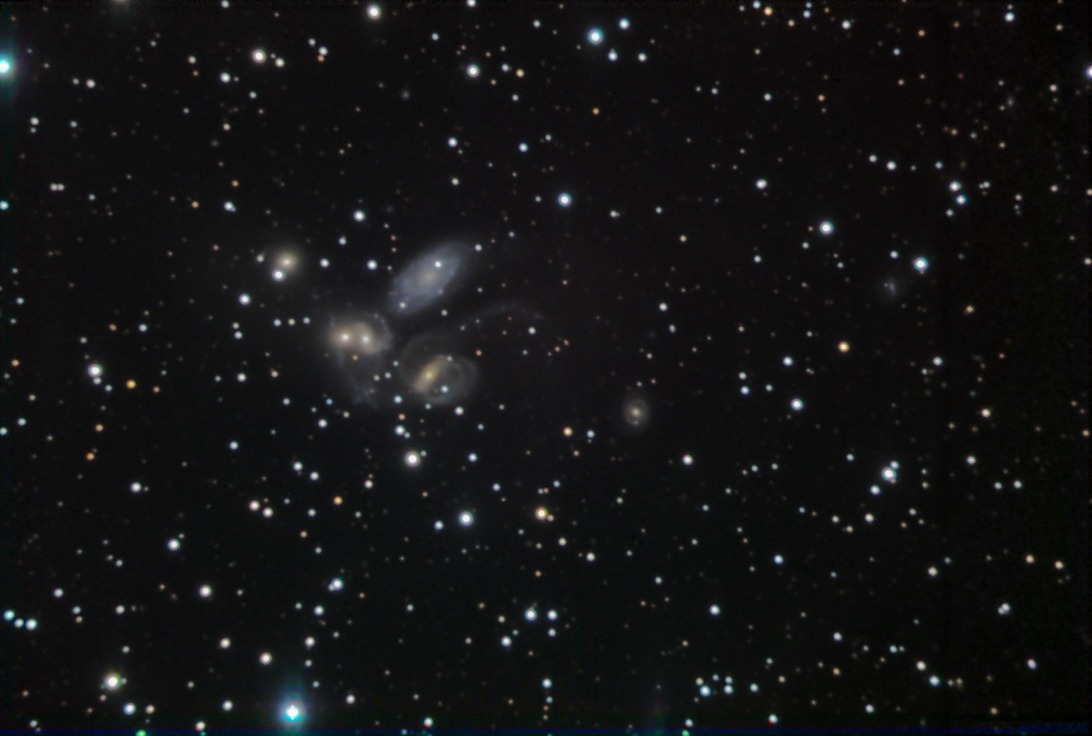
Data acquisition with CCDSoft. Reduced and aligned in CCDStack. Subs combined in Sigma Beta. RGB combined in AstroArt at 1:1:1.5 ratio. Arcsine stretch import of L into Photoshop. Adjusted curves and levels. Slight blur on the dim areas and sharpening on non-star bright areas. ~25% minimum filter on the brighter stars. L was combined with RGB using three layers: Luminance on the bottom; RGB as a multiply(30%); and RGB as a color layer on top. Final stretch and tweak (including fixing "dripping" stars) in Photoshop.
I am curious about thoughts on processing choices. I could boost the color saturation and try to match the recent Hubble image, but I really don't want cartoon colors. Boost contrast? Or would I lose subtle detail? More sharpening? I set the black level for a more uniform sky, but made some of the background galaxies really dim now. I might be able to tweak all of the above for weeks, but I worry how it will appear elsewhere. Thanks for any suggestions.
Charlie
Attached Image:
Fort Lewis Observatory: (37.238, -108.052) ~2360m (7744 ft.) elevation.
Darkness - typically 6.5+
Scope - Meade 16" LX200; f6.3 focal reducer
Focus - JMI Smart focus
Camera - SBIG ST-10XE; (~.5"/pixel)
Guiding - AO-8 and/or Meade 5"/DSI/PHD
http://www.fortlewis.edu/observatory
