Image of the day

Captured by
Shane Yarnall

LDN 1622

My Account

New to Astromart?

Register an account...

Need Help?

One more fix

Started by hakescl, 12/17/2008 06:49PM
Posted 12/17/2008 06:49PM Opening Post
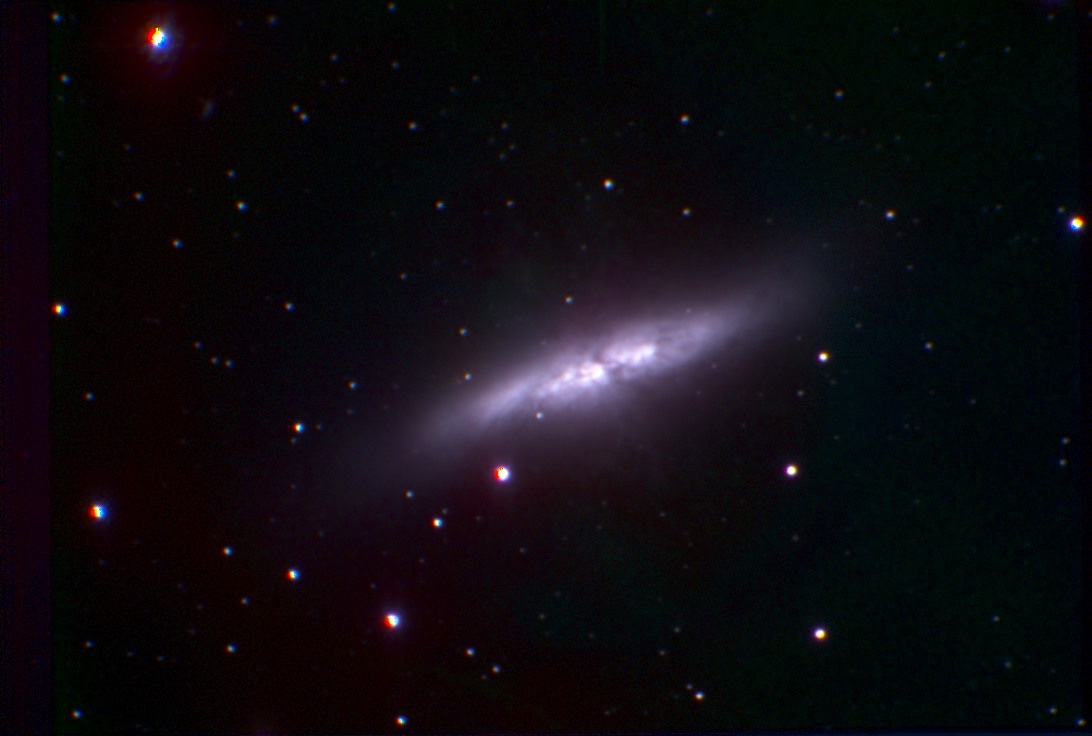
I had suspected some scaling differences with the SCT from night to night and now I have verified this. These are all luminance shots, but one night I defined as red, one green, and the third night blue. I aligned everything with CCDSoft. You can easily see the scale difference. Ouch! Things may eventually settle down with the mirror, but different elevation angles, temperature, etc...

Anyway, now I have CCDStack and it cleans up the messes. But I must come up with a different (for me) processing work flow. And I may need a computer upgrade, since the fancier alignment takes WAY longer on the vintage 2001 system.

At least I will have time to try a few things now, since I can't tell if we will ever get another clear night. And an irrigation system (very large rolling kind) got blown across the access road and then 2 feet of snow got dumped on it. So things may be inaccessible for a while.... @#$%&^%$

Charlie


Attached Image:

hakescl's attachment for post 44933

Fort Lewis Observatory: (37.238, -108.052) ~2360m (7744 ft.) elevation.
Darkness - typically 6.5+
Scope - Meade 16" LX200; f6.3 focal reducer
Focus - JMI Smart focus
Camera - SBIG ST-10XE; (~.5"/pixel)
Guiding - AO-8 and/or Meade 5"/DSI/PHD
http://www.fortlewis.edu/observatory
Posted 12/17/2008 07:19PM #1
Hi Charles,
Yeah, that is a real problem.
I have seen this once myself on a series of exposures. It was the red and blue just like yours. What was weird was how the brighter stars were effected, but the lesser ones seemed to line up just fine. I ran the subs through several programs for stacking and aligning and did get some results, but no matter what I did they never aligned properly. Yet, they were taken with the same scope on the same night. Still, there seemed to be a change in scaling in the outer image, but the center seemed OK.
I finally accepted that something had changed, perhaps the atmosphere or the camera slipped, that caused this issue. It has never happened again. :S

[SIZE="Large"][/SIZE][COLOR="Blue"][/COLOR] Floyd Blue grin
Amateur Imager
Posted 12/17/2008 07:51PM #2
The reason for the scaling difference could be due to the focal length of an SCT being variable (quite variable, in fact, changing from F10 to almost F14 when the mirror is moved from min to max focus position). This is caused by the moving mirror focusing system. If you can fix the position of the mirror by locking it down and then focus via an external focuser, the focal length will not change.

The other thing that can change the focal length is if the tube is made of aluminum. Then the mirror to secondary distance will change with temperature, and even an external focuser will not compensate for this change.

Finally, the mirror is made of Pyrex, which does have a small expansion co-efficient. Because of this, the radius of curvature of the main mirror will shrink slightly with falling temperature. This causes the focal length to shorten slightly, and is another variable due to temperature.

You are discoving some of the reasons why a large aperture telescope does not always produce better results when it comes to deep sky photography. Here is an example of the same object that you are trying to image, but taken with only 10 inches of aperture: http://www.bigcigarastronomy.com/PageMill_Resources/M82.jpg

A smaller imaging scope is definitely easier to mount and guide accurately than a large heavy scope, plus it is less affected by the variables of the night sky. While a large scope does give you more bang visually on deep sky, sometimes the opposite is true for imaging.

Rolando
