Image of the day

Captured by
Michael Scherman

M17 Swan-Omega Celestron C6 Hyperstar2

My Account

New to Astromart?

Register an account...

Need Help?

R, G and B

Started by mclemens, 04/17/2008 07:36PM
Posted 04/17/2008 07:36PM Opening Post
It becomes progressively harder to reduce noise as I move up the frequency spectrum. Is that normal? It's easier to get a clean red than green, and green is easier than blue. Is this all normal?

Is this noise difference due to sensitivity differences in my sensor yielding lower signal as I move up in frequency?

Will my TEC200ED be poorly spherically corrected in blue and thus soften all blue exposures?

Do you think my L exposures would be improved by filtering out UV/infrared?
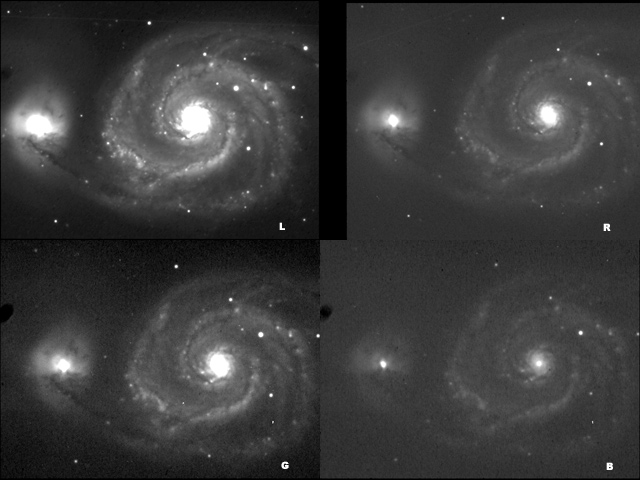
Attached Image:

mclemens's attachment for post 41700
Posted 04/17/2008 07:45PM #1
Hi Mike,
Yes, I think you can safely say this is true. The wave length as well as sensitivity is the cause I believe.
If your luminance filter is not IR/UV blocked, then a filter for that will help with star bloat.
As for the ED and the blue, well yes, there will be some loss from the spread of the blue spectrum, but it may not show so much as to be detrimental to the shot. I have a few shots taken with a Meade 178ED that are very good, with just a little blue halo around the very bright stars. This halo is very east to remove and then you can not tell it was there and the pictures look very good and close to what an APO gives.

[SIZE="Large"][/SIZE][COLOR="Blue"][/COLOR] Floyd Blue grin
Amateur Imager
Posted 04/19/2008 03:00PM #2
It all comes down to how much signal you are collecting. If a particular color channel seems noiser, then you need longer exposures in that channel, or more of them. This is normal. It results from a combination of your CCD sensor's sensitivity to various wavelengths, and from how much light your color filters are passing as well.

The simple correction is longer exposure times, so that you get similar signal to noise ratio in all color channels.

Unless you have a curve showing the focal point of various wavelengths for your scope, you would need to try the UV/IR blocking filters to see if they are of much benefit. Some scopes and correctors are fine well outside human vision; some are not. Generally, scopes that were designed originally for film are more likely to need UV/IR blocking. Scopes that were designed for the wider bandwidth of CCD sensors are more likely to handle UV/IR well.

Ron Wodaski
New Astronomy Press
http://www.newastro.com
