
Deep sky objects are limited in resolution due to atmospheric motion. Planet imagers have used video stacking techniques called Lucky Imaging for years now to get very high resolution details on the planets. Sub-arc second detail is possible using medium aperture scopes (10" to 16") on the surface of the planets and even their moons.
Deep sky has been limited to above 1 arc second, and in most cases between 2 and 4 arc sec FWHM because the atmospheric motion smears out the image even when guiding is excellent.
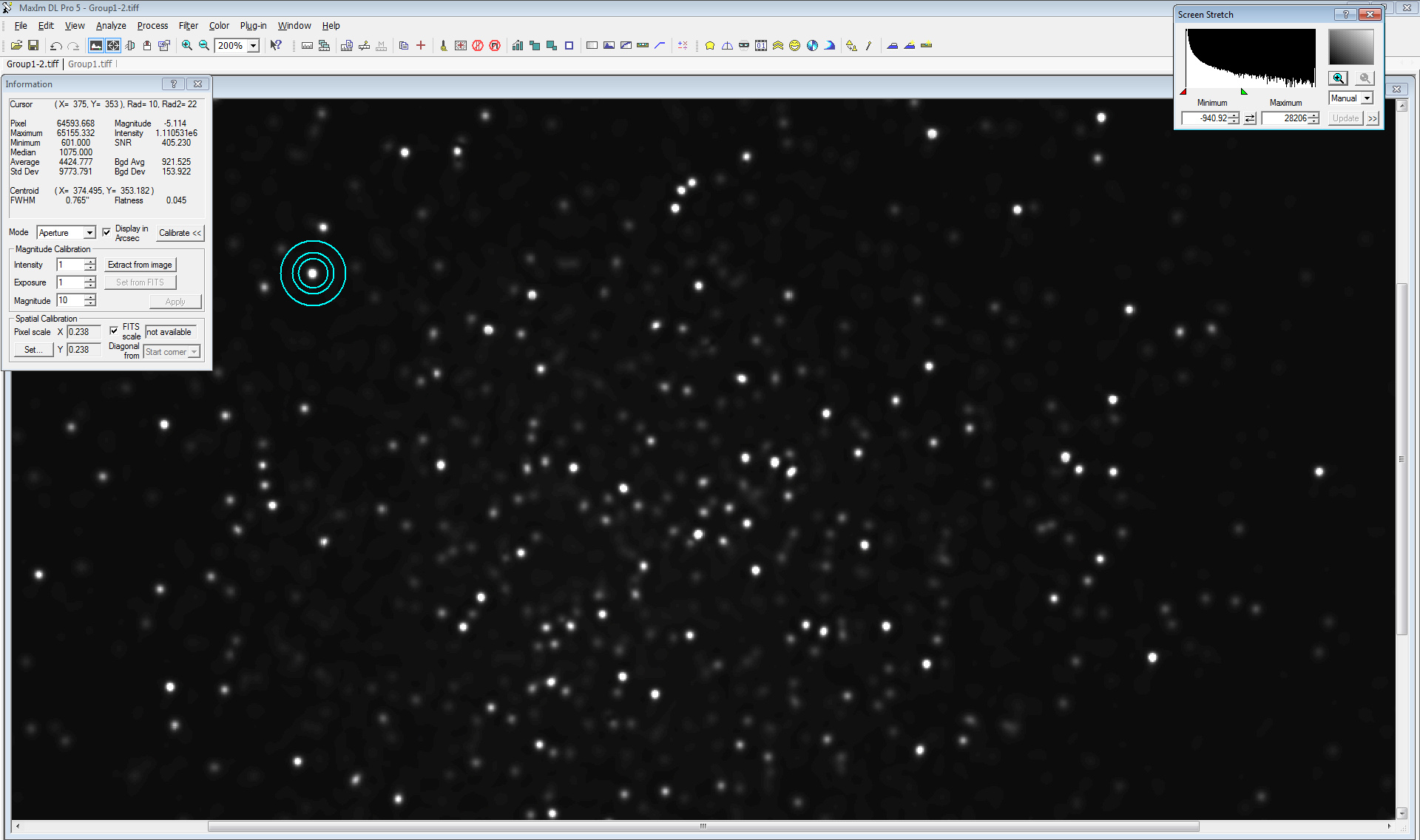
Last night I tried Video imaging of a fairly bright object, M13, using a QHY5-II Cmos camera attached to my 16" F8 astrograph. By stacking approximately 600 individual video frames I was able to get down to 0.765 arc seconds FWHM. And this was in so-so seeing, not a really good night. Over the next few days I plan to shoot more as the seeing improves, and add color to the image.
The attached image shows the resolution obtained in the core of M13. Video is of course limited in how deep you can go, but it might be possible to get fairly faint by stacking several tens of thousands of individual video frames. Planet imagers do this routinely now.
Rolando
Deep sky has been limited to above 1 arc second, and in most cases between 2 and 4 arc sec FWHM because the atmospheric motion smears out the image even when guiding is excellent.
Last night I tried Video imaging of a fairly bright object, M13, using a QHY5-II Cmos camera attached to my 16" F8 astrograph. By stacking approximately 600 individual video frames I was able to get down to 0.765 arc seconds FWHM. And this was in so-so seeing, not a really good night. Over the next few days I plan to shoot more as the seeing improves, and add color to the image.
The attached image shows the resolution obtained in the core of M13. Video is of course limited in how deep you can go, but it might be possible to get fairly faint by stacking several tens of thousands of individual video frames. Planet imagers do this routinely now.
Rolando
Attached Image:


