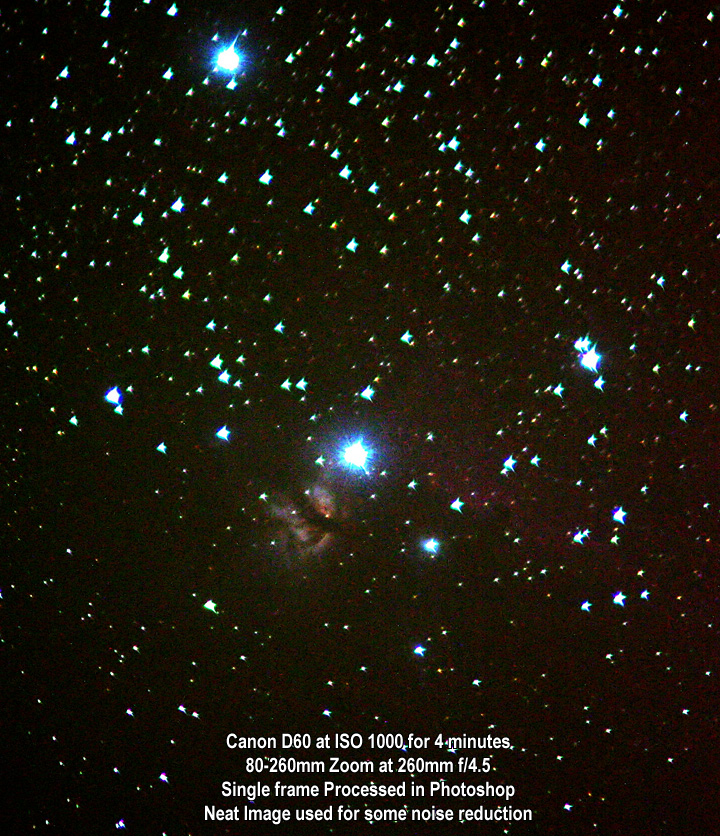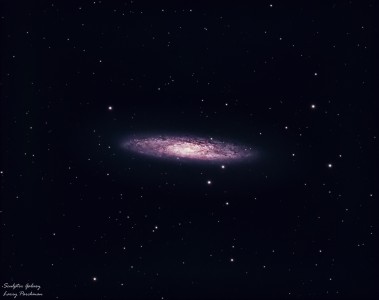
Far from perfect, but a promising start to imaging with my D60. I spent an all-nighter at the Salt Lake Astronomical Society's Stansbury Park Observatory II. I was enjoying the views through the 16" Ealing scope with Mark Bloomenthal and occasionally we would take a break and let the camera have a turn. Many thanks to Bruce Grim and Patrick Wiggins for a night spent aligning that awesome mount and scope so that I can look good just by pointing a camera and pressing a button. The scope tracks beautifully.
Most of these were taken through a Vivitar 80-260mm Zoom lens with an M42 mount piggy backed up on the finder rack of the Ealing. A nifty little adapter makes all of my m42 lenses fair game for my Canon EOS cameras, including the D60. The closer view of Orion was shot through a the Orion Apex 127mm Mak that we use as a finder scope for the 5000mm focal length Ealing.
I am going to have to schedule a night to go out and concentrate on just photography. The seeing was pretty bad with lots of turbulence in the upper atmosphere, although transparency was good. I am thinking that I need to be a little more careful about vibrations next time because I think that may have been what was causing some of these spiky stars. Any of you optical gurus have a better answer? It wasn't tracking, because I could take longer shots through the high power mack than I could using the short camera lenses. But the piggyback mount is at the end of a metal plate quite a ways from the center of the scope. I think the longer moment arm was letting it pick up vibrations the Mak didn't. Suggestions?
Each picture has info on how it was shot. Hope you like them. It gives me some hope for a long and happy love affair with my Canon D60 and the night sky.
Enjoy!
Paul McCarl
P.S. to Ron:
If you can't stand how bad I botched the processing, just email me and I will send you the source files so you can really impress us. My wife won't let me have your book until Christmas. That will teach me to tell her to buy it for me as a gift. I just assumed she would get it now and let me have it, but no...
Attached Image: