Hello,
I’m new to CCD imaging, and I’m having a rough time with detail. I have a Celestron 9.25 using a SBIG-237A CCD
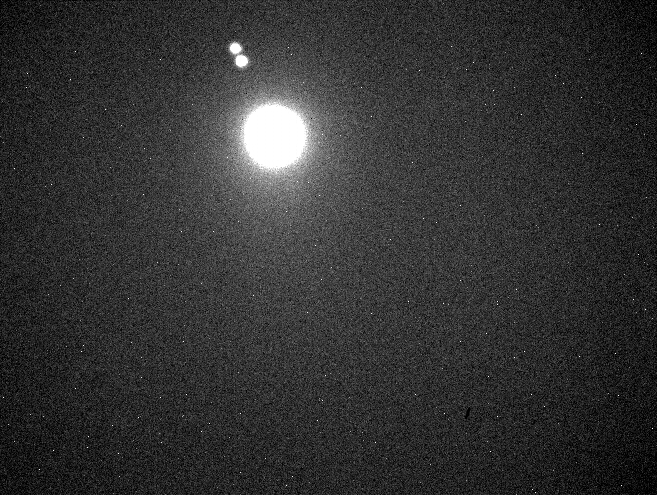
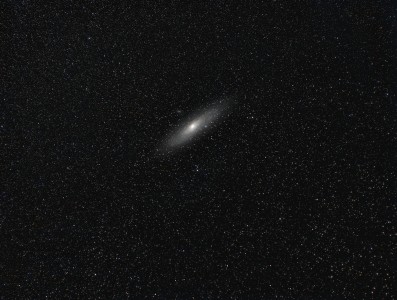
When I image clusters, the result is perfect minus my tracking and polar alignment although the image goes beyond the chip size. When I image the moon, my focusing is rather lacking but detail is sort of noticeable. When I try for planets, I get no detail. Same with stars (i.e. crispness). It’s as if I stuck a 4mm Nagler in and tried to focus using my eye rather than the camera; not a good result. So, between M13 and M8 going beyond the size of the chip, I have a few questions below.
As for focusing, I built a homemade focuser. Also, I have a focal reducer and flip mirror. The focal reducer is a Celestron 3.3 to bring me down to 6.3.
If I take the ratio of focal length/focal ratio = some number n/focal reducer ratio.. (i.e. 2350mm/f9.0 = n/6.3m), so that n = my new focal length.. is this the correct way of thinking in focal reducers? In other words, with a 6.3 focal reducer on f/9 2350 focal length telescope, is my focal length now 1645mm? Is this the right way of thinking? If this is the case, it must change true field of view, yes?
So, here are my questions. Sorry if they are a little mathematical in concept.
First, how do you determine magnification at prime focus on a 4mm chip at f/9? I don’t think it is the same as taking a focal length of scope divided by lens focal length to find magnification using an eyepiece. The reason I ask this is because I’m worried that I might have purchased a CCD that has too small a chip for the theoretical magnification of the scope ( I was told that for every inch of aperture gives 50X of magnification ). On the same token, I don’t think you figure magnification this way sense you are not manipulating focal length via the length of the eyepiece, as there is no eyepiece - only a chip. So, I’m wondering if true field of view shouldn’t be the dependent variable. It was my first assumption that any CCD would work on any quality scope.
Second, if magnification is not an issue at prime focus, how would you determine true field of view relative to the chip for any telescope. I want to know this because I’m considering the new Orion 80 ED and TeleVue 85 to lower magnification in hopes of obtaining detail and better tacking of the object at lower power since I’m using a CG-5 mount. I know I’m at the max for astrophotography with this mount.
And an off the topic question: How do I connect a Celestron Radial Guider to a Meade 1.25” Flip Mirror so that I have the following configuration?
Telescope>Focal Reducer>Radial Guider>Flip Mirror>CCD.
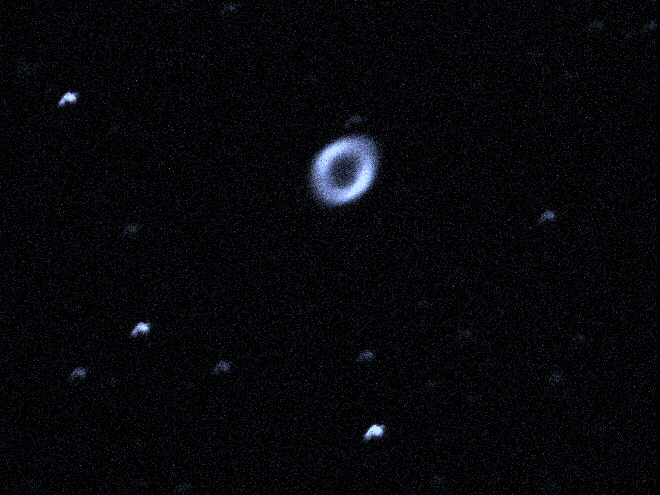
Below is an example what I’ve been able to do so far - Ring Nebula.
Any advice and equations are greatly welcomed.
~Brian
I’m new to CCD imaging, and I’m having a rough time with detail. I have a Celestron 9.25 using a SBIG-237A CCD
When I image clusters, the result is perfect minus my tracking and polar alignment although the image goes beyond the chip size. When I image the moon, my focusing is rather lacking but detail is sort of noticeable. When I try for planets, I get no detail. Same with stars (i.e. crispness). It’s as if I stuck a 4mm Nagler in and tried to focus using my eye rather than the camera; not a good result. So, between M13 and M8 going beyond the size of the chip, I have a few questions below.
As for focusing, I built a homemade focuser. Also, I have a focal reducer and flip mirror. The focal reducer is a Celestron 3.3 to bring me down to 6.3.
If I take the ratio of focal length/focal ratio = some number n/focal reducer ratio.. (i.e. 2350mm/f9.0 = n/6.3m), so that n = my new focal length.. is this the correct way of thinking in focal reducers? In other words, with a 6.3 focal reducer on f/9 2350 focal length telescope, is my focal length now 1645mm? Is this the right way of thinking? If this is the case, it must change true field of view, yes?
So, here are my questions. Sorry if they are a little mathematical in concept.
First, how do you determine magnification at prime focus on a 4mm chip at f/9? I don’t think it is the same as taking a focal length of scope divided by lens focal length to find magnification using an eyepiece. The reason I ask this is because I’m worried that I might have purchased a CCD that has too small a chip for the theoretical magnification of the scope ( I was told that for every inch of aperture gives 50X of magnification ). On the same token, I don’t think you figure magnification this way sense you are not manipulating focal length via the length of the eyepiece, as there is no eyepiece - only a chip. So, I’m wondering if true field of view shouldn’t be the dependent variable. It was my first assumption that any CCD would work on any quality scope.
Second, if magnification is not an issue at prime focus, how would you determine true field of view relative to the chip for any telescope. I want to know this because I’m considering the new Orion 80 ED and TeleVue 85 to lower magnification in hopes of obtaining detail and better tacking of the object at lower power since I’m using a CG-5 mount. I know I’m at the max for astrophotography with this mount.
And an off the topic question: How do I connect a Celestron Radial Guider to a Meade 1.25” Flip Mirror so that I have the following configuration?
Telescope>Focal Reducer>Radial Guider>Flip Mirror>CCD.
Below is an example what I’ve been able to do so far - Ring Nebula.
Any advice and equations are greatly welcomed.
~Brian
Attached Image: