
Tonight's experiment, a diminutive shot of Venus using a Hoya R72 infra-red pass filter
http://setisociety.org/VENUS-MVI_1248regoneroxnoresz.jpg
The filter doesn't pass any light that is less than 720nm. As you probably have surmised, the reddish color is not natural but caused by the filter.
As some of you already know, although digital consumer cameras (like the Canon A590 that I used for this shot) have IR cut filters, they sometimes still pass a significant amount of near IR and IR. If you take a remote control from your TV, DVD etc. and point it at your digital camera, you can see the normally invisible flashes through your camera LCD screen.
I suspect that any details that appear in this particular image in the clouds are likely processing remnants from Registax trying to figure out what to do with such a dim and poor AVI as the one I used (I wasn't near thermal equilibrium and Venus was getting low; I should really try this during the daytime when Venus is near the meridian!) but Registax seems to have figured out the shape O.K. as Venus was supposed to be at around 65% illumination when the shot was taken afocally via the Criterion and a 10mm EP.
The IR-pass filter is a 58mm one usually used for photography, I just hooked the edge of it over the end between the extended point-n-shoot lens and the telescope eyepiece and crossed my fingers.
Regards, Jason H.
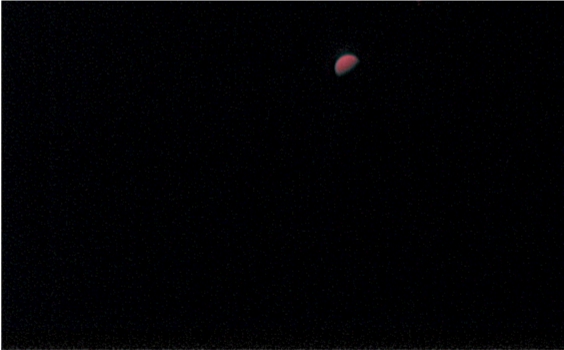
http://setisociety.org/VENUS-MVI_1248regoneroxnoresz.jpg
The filter doesn't pass any light that is less than 720nm. As you probably have surmised, the reddish color is not natural but caused by the filter.
As some of you already know, although digital consumer cameras (like the Canon A590 that I used for this shot) have IR cut filters, they sometimes still pass a significant amount of near IR and IR. If you take a remote control from your TV, DVD etc. and point it at your digital camera, you can see the normally invisible flashes through your camera LCD screen.
I suspect that any details that appear in this particular image in the clouds are likely processing remnants from Registax trying to figure out what to do with such a dim and poor AVI as the one I used (I wasn't near thermal equilibrium and Venus was getting low; I should really try this during the daytime when Venus is near the meridian!) but Registax seems to have figured out the shape O.K. as Venus was supposed to be at around 65% illumination when the shot was taken afocally via the Criterion and a 10mm EP.
The IR-pass filter is a 58mm one usually used for photography, I just hooked the edge of it over the end between the extended point-n-shoot lens and the telescope eyepiece and crossed my fingers.
Regards, Jason H.
Attached Image:
