
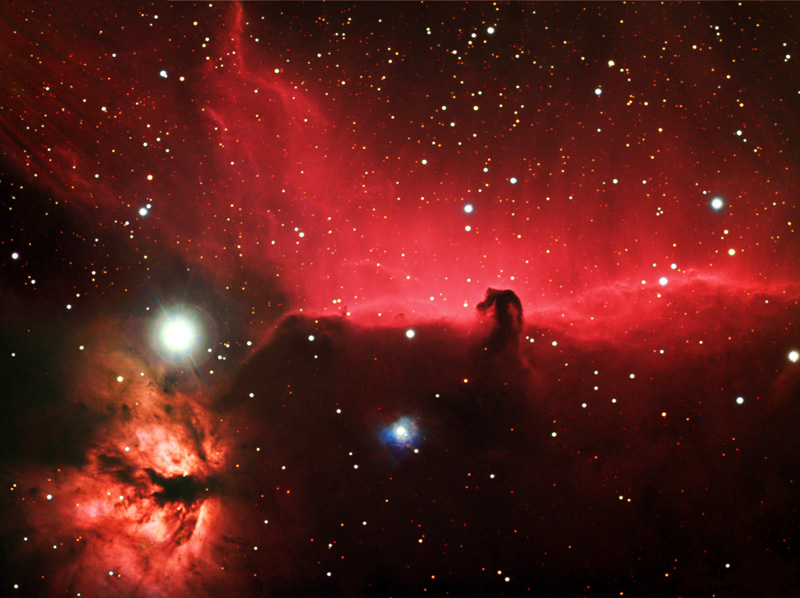
This is sort of a test image for me. I took recent data from my FSQ and ST2000-XM and combined it with some deep Ha data from the ST-10XE and FSQ taken in January 2002. I used Registar to align these images since they were at different plate scales. I blended the 180m of R data from the ST2000-XM with 210m of Ha data in an attempt to reduce the blue halos that can result when using Ha for the L layer; it worked generally well, although there are still smallish blue halos--although I don't find them objectionable.
I really like the very smooth appearance I got with so much data, and how deep I was able to go, especially in the area below the HH, which is often shown as black, but is really full of faint nebulosity.
After registration in Registar, image assembly was done in Photoshop CS, followed by curves, levels, saturation and contrast adjustments. The L layer of Ha data was adjusted separately with many of the same steps, including some light unsharp masking to reveal details in the nebulosity.
Total integration time for this image is 8.5 hours: 3.5 hours of Ha, 3 hours of R, and one each of G and B. This image was reduced 50% for posting.
Jeff
I really like the very smooth appearance I got with so much data, and how deep I was able to go, especially in the area below the HH, which is often shown as black, but is really full of faint nebulosity.
After registration in Registar, image assembly was done in Photoshop CS, followed by curves, levels, saturation and contrast adjustments. The L layer of Ha data was adjusted separately with many of the same steps, including some light unsharp masking to reveal details in the nebulosity.
Total integration time for this image is 8.5 hours: 3.5 hours of Ha, 3 hours of R, and one each of G and B. This image was reduced 50% for posting.
Jeff
Attached Image:
Jeff 8O

