Hi everyone,
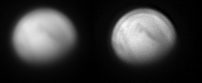
I have some limited experience with deep sky imaging, but am trying to branch out into lunar and planetary imaging as well. Of course, I am trying to learn things the hard way by starting with Mars. I took the attached photo on October 9 (my second night to attempt planetary imaging) with a LU075 camera, C9.25 SCT, Televue 3x barlow and Astronomik type IIC red filter. The left image is a raw stack of about 300 frames (best 300 of 700) and the right picture has some wavelet filtering applied.
I'm wondering what the ring is (and what to do about it) around the bright side of Mars. I didn't make any adjustments to the gamma when I captured the frames, and the gain didn't have to be turned up much to get adequate signal. The effect is not nearly as pronounced in images from green and blue filters. At first I thought it was just the effect of atmospheric turbulence, but enough detail is visible that it doesn't seem probable.
Any help or suggestions would be greatly appreciated!
Thanks,
Steve Keltner
I have some limited experience with deep sky imaging, but am trying to branch out into lunar and planetary imaging as well. Of course, I am trying to learn things the hard way by starting with Mars.
I took the attached photo on October 9 (my second night to attempt planetary imaging) with a LU075 camera, C9.25 SCT, Televue 3x barlow and Astronomik type IIC red filter. The left image is a raw stack of about 300 frames (best 300 of 700) and the right picture has some wavelet filtering applied.I'm wondering what the ring is (and what to do about it) around the bright side of Mars. I didn't make any adjustments to the gamma when I captured the frames, and the gain didn't have to be turned up much to get adequate signal. The effect is not nearly as pronounced in images from green and blue filters. At first I thought it was just the effect of atmospheric turbulence, but enough detail is visible that it doesn't seem probable.
Any help or suggestions would be greatly appreciated!
Thanks,
Steve Keltner
Attached Image:
