
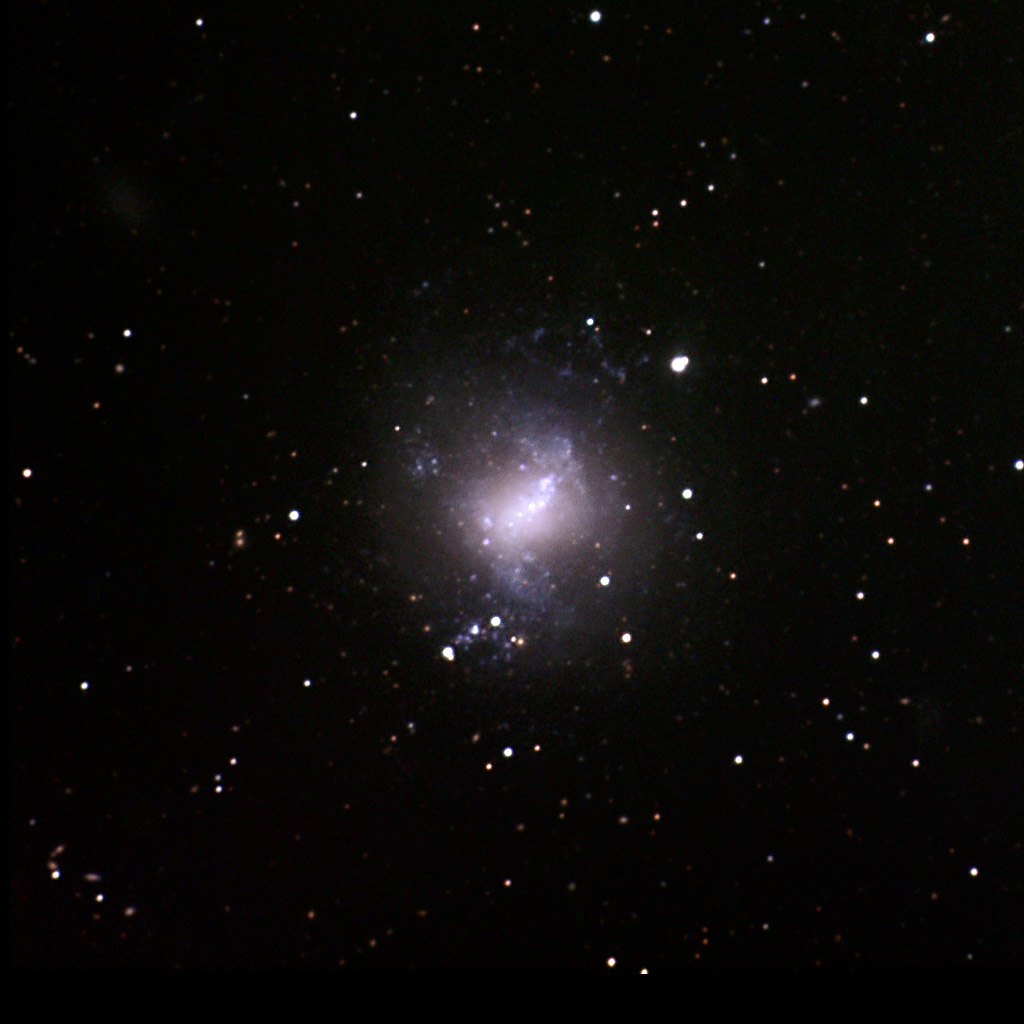
Here's another very interesting galaxy. I couldn't really find any color images of it, at least not via Google, so I'm relying on my color calibration here. The exposures for this image are a mixed bag. I started out with five 5-minute luminance, but I though they were a little thin because of how dim this galaxy is. So I then took 6 10-minute images. To combine all the data effectively, I created two 3-image median combines with the 5-minute images (yes, one image got used in each median combine; a high cosmic ray count necessitated this approach), and summed them together to create and extra 10-minute image. I then median combined all the 10-minute images for a master luminance.
Otherwise, processing was done normally, with color combine in MaxIm DL and color and luminance processing in Photoshop.
The very dim galaxy at upper left is UGCA276, a mag 15 galaxy with really low surface brightness. Even an extreme histogram stretch reveals a mere smudge.
NGC 4214 may not be often imaged, but scientifically it is a very interesting galaxy. It is a Magellanic dwarf (therefore one of our neighbors) and it is undergoing rampant star formation. The red core is an older population of stars that appears to be very uniformly distrubuted, while the hot, young stars in the blue areas are presumably forming from interactions with other galaxies in the neighborhood. The core is pretty bright, making this a mag 10 galaxy overall, but the interesting details away frmo the core are very dim and required fairly long exposures.
Taken with the C14/ST-1001E using the Newastro Remote Telescope.
Ron Wodaski
http://www.newastro.com/remote
Otherwise, processing was done normally, with color combine in MaxIm DL and color and luminance processing in Photoshop.
The very dim galaxy at upper left is UGCA276, a mag 15 galaxy with really low surface brightness. Even an extreme histogram stretch reveals a mere smudge.
NGC 4214 may not be often imaged, but scientifically it is a very interesting galaxy. It is a Magellanic dwarf (therefore one of our neighbors) and it is undergoing rampant star formation. The red core is an older population of stars that appears to be very uniformly distrubuted, while the hot, young stars in the blue areas are presumably forming from interactions with other galaxies in the neighborhood. The core is pretty bright, making this a mag 10 galaxy overall, but the interesting details away frmo the core are very dim and required fairly long exposures.
Taken with the C14/ST-1001E using the Newastro Remote Telescope.
Ron Wodaski
http://www.newastro.com/remote
Attached Image:
Ron Wodaski
New Astronomy Press
http://www.newastro.com

